So Close, and Never There
Scientists at the University of Bremen once cooled matter to 38 picokelvin. That is just 38 trillionths of a degree above absolute zero. It sounds like they almost made it. In truth, they never can. Absolute zero is the coldest temperature possible, and physics says it can be approached but never reached.
On the Kelvin scale, absolute zero is simply 0 K. In Celsius it is minus 273.15 degrees, and in Fahrenheit it is minus 459.67 degrees. At this point, a system's internal energy drops to its lowest possible value.
The rule that keeps it out of reach is the third law of thermodynamics. It means no physical process can get there in a finite number of steps. The closer you get, the harder each next step becomes, no matter which cooling method you use.
Shrinking Air Pointed the Way
Long before anyone could make things very cold, people guessed where the bottom might be by watching air. In 1703 the French physicist Guillaume Amontons worked with an air thermometer. He argued that its zero would be the temperature at which the "spring" of the air dropped to nothing. His estimate worked out to about minus 240 degrees Celsius.
Others were far off. In a 1780 treatise, Pierre-Simon Laplace and Antoine Lavoisier came up with values of 1,500 to 3,000 degrees below freezing. John Dalton made ten calculations and finally chose minus 3,000 degrees Celsius.
The real clue came from gases. Between 1787 and 1802, researchers found that a gas at constant pressure shrinks by about 1/273 of its volume for each degree it cools. Follow that line down, and the volume hits zero at about minus 273 degrees. In 1848 Lord Kelvin built a temperature scale that did not depend on any particular substance, and its zero landed in almost the same spot.
The Race to Turn Every Gas Into Liquid
Once scientists knew the target, they raced toward it. By 1845 Michael Faraday had turned most known gases into liquids and set a record low of minus 130 degrees Celsius. He believed oxygen, nitrogen and hydrogen were "permanent gases" that could never become liquid. He was wrong. In 1877 Louis Paul Cailletet in France and Raoul Pictet in Switzerland made the first droplets of liquid air.
The last prizes were hydrogen and helium, and two rivals chased them. The Scottish scientist James Dewar liquefied hydrogen in 1898, after 20 years of effort. But the Dutch physicist Heike Kamerlingh Onnes beat him to helium in 1908.
Kamerlingh Onnes then lowered the pressure over his liquid helium and got down to about 1.5 K. These were the coldest temperatures on Earth at the time, and they won him the Nobel Prize in 1913. He went on to describe superconductivity and superfluids for the first time.
Helium That Refuses to Freeze
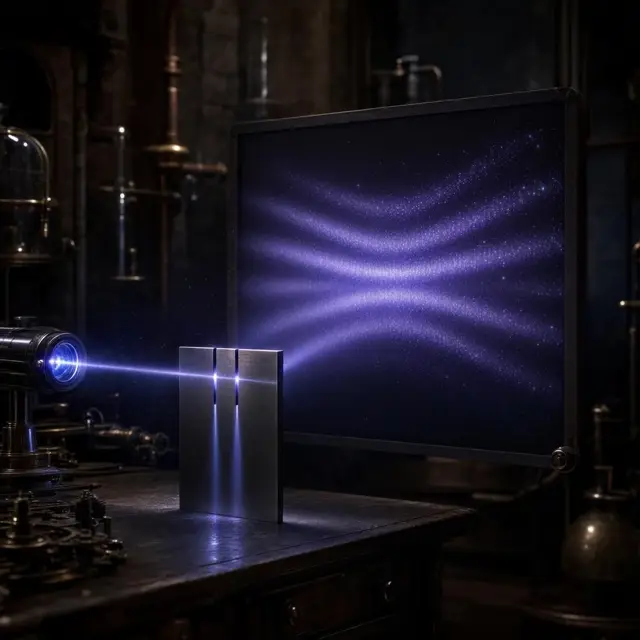
Matter stops acting normally close to absolute zero. Strange quantum effects appear, such as superconductivity, superfluidity and Bose-Einstein condensation. And even at absolute zero, particles never sit perfectly still. They keep a small, unavoidable motion called zero-point energy, required by the Heisenberg uncertainty principle.
That motion explains a famous oddity. Liquid helium will not freeze at normal pressure, even near absolute zero. Helium atoms are light and pull on each other only weakly, so their zero-point motion stops them from settling into a solid. Only high pressure squeezes them into one.
Stranger still, some special systems can reach negative temperatures on the Kelvin scale. These are not colder than absolute zero. They are actually hotter than any positive temperature. If such a system touches a normal one, heat flows out of the negative-temperature system and into the other.
Record Chills in Labs and in Space
The universe itself is cold, but not that cold. Its average temperature today is about 2.73 K, based on measurements of the cosmic microwave background radiation. The coldest natural place ever recorded is the Boomerang Nebula. It has been blowing out gas at 500,000 km/h for 1,500 years, which has chilled it to about 1 K.
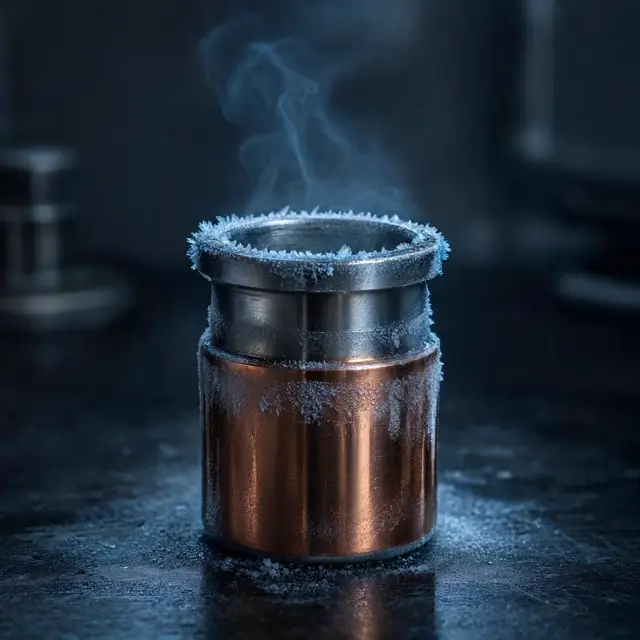
Labs have gone much further. In 2014 a team in Italy cooled a copper vessel of one cubic meter to 0.006 K and kept it there for 15 days. No volume that large is known to have been colder anywhere in the universe. Laser cooling has reached less than a billionth of a kelvin.
Space is now a cold lab too. The Cold Atom Laboratory, built for the International Space Station, uses the weightless conditions there to create Bose-Einstein condensates. Temperatures as low as 1 picokelvin are expected to be possible on board.