Einstein's "Spooky" Nightmare
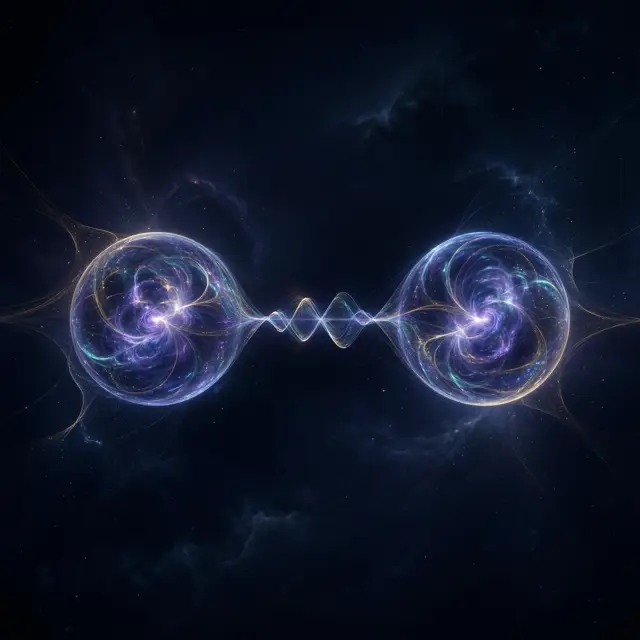
Imagine two coins that always land on opposite faces, no matter how far apart you flip them, even one on Earth and one on the Moon. That is roughly what happens with quantum entanglement, and it troubled Albert Einstein so much that he refused to accept it at face value.
In 1935, Einstein teamed up with physicists Boris Podolsky and Nathan Rosen to publish a paper attacking quantum mechanics. Their argument, now called the EPR paradox, claimed the theory must be incomplete because it demanded that measuring one particle could instantly affect a partner particle far away.
Einstein had a name for this unsettling idea: spooky action at a distance. He believed hidden, undiscovered properties inside each particle, not real spooky influence, must explain the connection. Decades of experiments would eventually prove him wrong.
A Bet Two Particles Can't Break
Here is the strange part: when two particles become entangled, their fates lock together no matter the distance between them. If scientists create a pair of particles with a combined spin of zero, and then measure one particle's spin and find it pointing one way, the other particle's spin, measured on the same axis, will always point the opposite way.
This is not a coincidence baked in at creation. Before either particle is measured, neither one has a fixed spin at all. Only the act of measuring seems to force a decision, called a wave function collapse, and that decision instantly ties itself to the far-away partner.
Scientists have proven this correlation using properties like position, momentum, spin, and polarization, always with perfect agreement between entangled partners, however far apart they travel.
The Math That Called Einstein's Bluff
For nearly 30 years, Einstein's hidden-variable idea seemed impossible to disprove. Then in 1964, physicist John Bell found a clever way to test it mathematically. He showed that any theory built on local realism, the common-sense idea that particles carry fixed hidden properties before measurement, must obey a strict statistical limit, now called Bell's inequality.
Quantum mechanics predicted that entangled particles would break this limit. It was a bet the universe could actually settle.
Experiments soon put the question to the test. Stuart Freedman and John Clauser ran early trials in 1972, and physicist Alain Aspect sharpened the tests further in 1982. Again and again, entangled particles violated Bell's inequality, confirming quantum mechanics and ruling out simple hidden variable explanations once and for all.
A Nobel Prize Decades in the Waiting
Proving Einstein wrong took nearly a century, but the physics world eventually gave it the recognition it deserved. In 2022, the Nobel Prize in Physics went jointly to Alain Aspect, John Clauser, and Anton Zeilinger for their landmark experiments with entangled photons.
Their work did not just settle an old philosophical argument. By establishing that Bell's inequality really is violated in nature, they helped launch an entirely new field: quantum information science, which studies how entanglement can be harnessed rather than just observed.
The prize committee singled out their careful, decades-long experimental effort as the foundation for technologies that once existed only in thought experiments, from unbreakable codes to computers that work in fundamentally new ways.
From Tiny Diamonds to Quantum Computers
Entanglement is not just a lab curiosity confined to single particles anymore. Scientists have entangled photons, electrons, top quarks, entire molecules, and even small diamonds, showing the effect reaches further into the everyday world than Einstein ever imagined.
The applications are just as striking. Quantum teleportation, a way to transfer a particle's exact state to a distant partner, was proposed in 1992 and achieved in the lab by 1997. Entangled photons also enable quantum key distribution, a method of creating secret codes so secure that any eavesdropper's presence gives itself away through disturbed measurements.
One catch remains: entanglement can produce spooky correlations across vast distances, but it still cannot send a message faster than light. Nature keeps its speed limit, even while bending the rules everywhere else.