Two Slits, and Light Draws Stripes
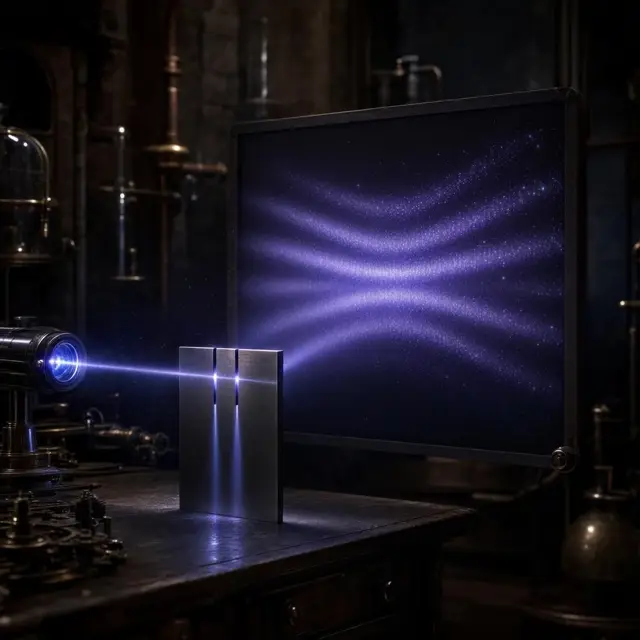
Point a laser at a wall through two narrow slits, and you would expect two bright stripes, one per slit. Instead you get a whole zebra pattern of bright and dark bands running across the wall. Thomas Young first described this setup in 1801, and he used it to argue that light travels as a wave, not as a stream of tiny particles.
The banding happens because light spreading out from each slit overlaps with light from the other slit. Where two wave peaks arrive together, they add up into a bright band. Where a peak meets a trough, they cancel out into darkness. This banding is called an interference pattern, and only waves were thought to produce it this way.
Firing One Speck of Light at a Time
Here is where things stop making sense. Scientists lowered the light so dim that only one photon at a time passed through the slits, with long gaps between each one. Every single photon still landed on the screen as one dot, like a tiny bullet, not a spread-out wave.
But leave the experiment running for hours, and those individual dots slowly pile up into the exact same striped interference pattern as before. In 1909, G. I. Taylor ran this dim-light version and watched the stripes emerge from thousands of lonely photon hits. Somehow, each photon seems to interfere with itself, as if it travels through both slits at once.
The same trick works with electrons. In 1974, physicists fired electrons through a double slit one at a time and filmed the striped pattern slowly building up, dot by dot, on camera.
The Pattern Vanishes the Moment You Look
Physicists then tried something sneaky: placing a tiny detector at each slit to record which one a particle actually went through. The instant they did that, the striped interference pattern disappeared completely, replaced by two plain clumps, one behind each slit, exactly what you would expect from ordinary particles.
Nothing about the setup changed except the measurement itself. Checking a particle's path, known as which-path information, seems to force it to behave like a solid object instead of a spread-out wave. Turn the detectors off, and the stripes come right back.
Even stranger, so-called quantum eraser experiments show that if the which-path information is later erased, before anyone actually looks at it, the interference pattern can reappear, even for particles that already hit the screen.
From a Single Electron to 2,000-Atom Molecules
In 1927, two separate research teams, one led by Clinton Davisson and Lester Germer and another by George Paget Thomson, fired beams of electrons at crystal targets and found the same striped interference pattern that light produces. That meant matter itself behaves like a wave, not just light.
Since then, physicists have pushed the experiment onto bigger and bigger objects. In 1961, Claus Jönsson ran it using coherent beams of electrons instead of light. By 2019, researchers had done it with molecules built from 2,000 atoms each, weighing about 25,000 daltons, a unit used to measure the mass of atoms and molecules. Those molecules are the largest objects ever shown to interfere with themselves like a wave.
The Only Mystery of Quantum Mechanics
Physicist Richard Feynman loved this experiment so much that he said it was impossible to explain in any classical way, and that it holds the heart of quantum mechanics. He went further, calling it the only real mystery the theory has to offer.
Readers of the magazine Physics World later agreed with him in spirit: they voted the single-electron version of this experiment the most beautiful experiment in the history of physics. Over two centuries after Young first split a beam of light in two, scientists still have not fully agreed on why watching a particle changes what it does.