Two Meters Packed Into Every Cell
Stretch out the DNA coiled inside the nucleus of one human cell and it would run about two meters — 208 centimeters, to be precise, holding some 6.4 billion base pairs across 46 chromosomes. Your largest single chromosome carries about 220 million base pairs and would measure 85 millimeters straightened out. All of it folds into a nucleus far too small to see.
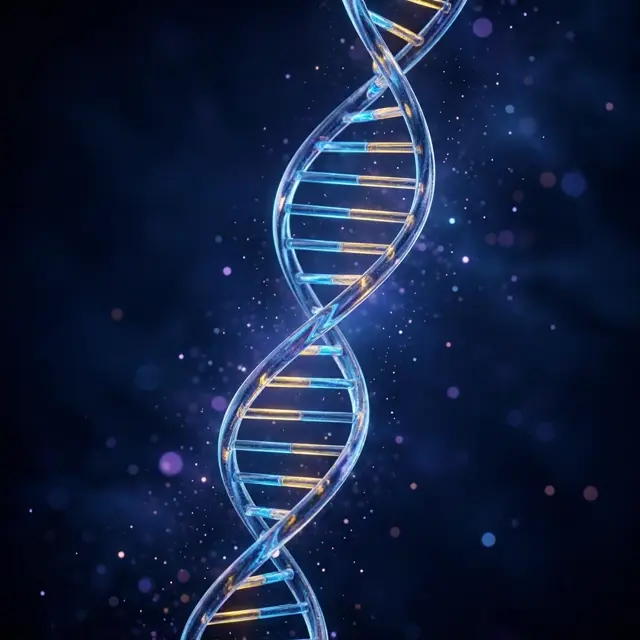
The molecule itself is a double helix: two strands twisting around each other, each a chain of units called nucleotides built on a sugar-phosphate backbone. The strands run in opposite directions, and pure extracted DNA looks surprisingly mundane — white, stringy clumps, like overcooked cotton.
A Four-Letter Alphabet That Writes Everything Alive
All the instructions for building and running you are written in just four chemical letters: adenine (A), thymine (T), guanine (G), and cytosine (C). The genius is in the pairing rules — A always bonds with T, and G always with C, across the two strands of the helix. G-C pairs hold with three hydrogen bonds versus A-T's two, making G-C-rich stretches of DNA more stable.
This pairing is what makes life copyable. Split the helix down the middle and each strand dictates its partner perfectly: the base on the old strand determines which base joins the new one. When a cell divides, enzymes unzip the molecule and rebuild two identical copies — three billion letters, duplicated. The recipe for a human, written in an alphabet of four.
The Race to the Helix
DNA was discovered long before anyone knew what it did. In 1869, Swiss chemist Friedrich Miescher isolated a substance from cell nuclei he called "nuclein" — DNA, unrecognized. The molecule's true shape stayed hidden for another 84 years.
The breakthrough came in 1953, when James Watson and Francis Crick published their double-helix model. Crucially, their model was built on X-ray diffraction images of DNA produced by Rosalind Franklin and Maurice Wilkins — crystallography data that revealed the molecule's helical geometry. Franklin's contribution, undervalued in her lifetime, is now recognized as pivotal to one of the great discoveries of the twentieth century.
Damage, Repair, and the Cost of Living
Your DNA is under constant attack. Ultraviolet light welds neighboring bases into distorting kinks; oxidants chemically scar the letters. At any given moment, a typical human cell carries about 150,000 bases suffering oxidative damage. The most dangerous wounds are double-strand breaks — cuts through both strands at once that can lead to cancer, and whose slow accumulation contributes to aging itself.
Here's the humbling part: less than 10% of your genome has a defined functional role. And the ends of your chromosomes are capped by telomeres — stretches of the repeated sequence TTAGGG that act like the plastic tips of shoelaces, protecting the precious code inside from fraying away.
From Crime Scenes to Hard Drives
Because no two people share the same full sequence, DNA became the ultimate identifier. DNA profiling places suspects at crime scenes and settles paternity; fragments of fetal DNA floating in a mother's blood now allow prenatal screening without touching the womb. Ancient DNA pulled from bones and even soil rewrites the history of species and civilizations.
Engineers have pushed further. Scientists have built Hachimoji DNA — an expanded genetic alphabet with four artificial letters added to nature's four. And because DNA packs information more densely than any hard drive, researchers are seriously developing it as a storage medium for digital data. The molecule that has stored life's information for billions of years may end up storing our photos too.