Seeing With Sound
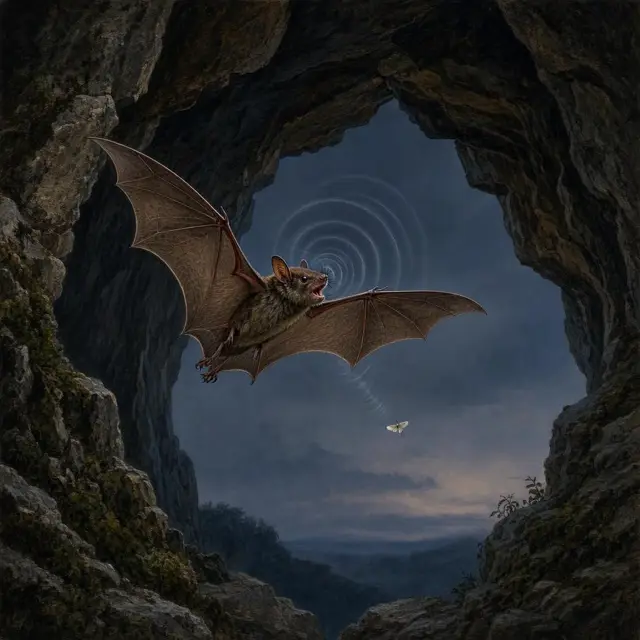
A bat can tell two targets apart even when they sit less than half a millimeter from each other, using nothing but sound. That trick is echolocation, a kind of active sonar. The animal makes its own calls, then listens for the echoes that bounce back from things nearby. The delay between call and echo tells it how far away something is.
Animals do this with one sound source and just two receivers: their ears. An echo reaches each ear at a slightly different time and loudness, and that tiny gap reveals the direction. From echoes alone, a bat can judge where it is going, how big another animal is, and even what kind of animal it is.
Working this out took a long time. In the 1700s, Lazzaro Spallanzani showed that night-flying bats rely on some sense besides sight. In 1798 Louis Jurine concluded that the sense was hearing. The word echolocation had been coined by 1944 by the American zoologist Donald Griffin.
Turning the Volume Up and Down
Bat calls range from as low as 11 kHz to as high as 212 kHz. Most of that is far above human hearing, which tops out around 20,000 Hz, so the calls are mostly ultrasound. They can also be loud, measured at anywhere between 60 and 140 decibels. Some bats lower their volume in the middle of a call as they get close to objects that reflect sound strongly, so the returning echo does not deafen them.
While searching, a bat makes about 10 to 20 clicks a second. Each call is linked to its breathing, which is linked to its wingbeat, so echolocation costs a flying bat almost no extra energy. Once it spots prey, it speeds up and finishes with a terminal buzz of up to 200 clicks a second.
There is a catch. A bat listens for echoes from only one call at a time. With a gap of 100 milliseconds between calls it can sense objects up to 17 meters away, but with a gap of 5 milliseconds only 85 centimeters.
Sweeping Calls and Steady Calls
Bats use two basic kinds of call. A sweeping call slides down through many pitches, while a steady call holds one pitch the whole time. The sweeping kind gives very precise distance, which is how bats separate targets less than half a millimeter apart. It works best for hunting in close, cluttered places, because the calls are short and can be fired off very quickly.
The steady kind reaches farther and has another superpower. When an insect flaps its wings, the pitch of the echo shifts because of the Doppler shift. Horseshoe bats hunt this way, and the flutter helps them tell a flying target from a still one. They even lower the pitch of their own call so the echo stays at the exact pitch their ears are tuned to.
Their ears are built for it. In the greater horseshoe bat, an extra large patch of the inner ear responds to sounds around 83 kHz, the pitch of its echo. This patch is called an acoustic fovea. Bats also have inner ear hair cells that are especially resistant to loud noise.
Dolphins, Shrews and Cave Birds
Bats are not alone. Echolocation evolved again and again in different animals, a clear example of convergent evolution. Toothed whales, including dolphins, porpoises and sperm whales, use it underwater, where vision is often very limited.
A toothed whale makes clicks by passing air through structures called phonic lips. A large fatty organ called the melon focuses the sound like a lens, because it is made of fats with different densities. Echoes come back mainly through fatty parts around the lower jaw, which pass the sound on to the middle ear. Changing how fast it clicks gives the bottlenose dolphin its familiar barks, squeals and growls. A run of more than 600 clicks a second is called a burst pulse.
Some birds echolocate too. Oilbirds and some swiftlets use a simpler version to fly through the caves and trees where they live. On land, shrews, the tenrecs of Madagascar and Chinese pygmy dormice are known or thought to use it. Blinded laboratory rats may find their way through mazes this way, and some blind people have learned to make brief sounds and listen for the echo.
The Moths Strike Back
Being hunted by sonar has pushed some insects to fight back. Many moths can hear bat calls, even though moth ears evolved before bats even existed. The result is what scientists call an evolutionary arms race between moths and bats.
Tiger moths answer a bat attack with a fast, speeding series of clicks. One species, Bertholdia trigona, jams bat sonar outright. In tests, bats made contact with silent moths 400% more often than with this one. Other moth clicks work as a bluff to startle the bat, or as an honest warning that the moth tastes bad, a strategy known as aposematism.
Some moths use their bodies instead. The African moon moth has long tails on its hindwings that swing in flight and create echoes, pulling the attack away from its body and onto the tails. The greater wax moth drops, loops or freezes when it hears ultrasound. Bats have counter moves too. A bat called Euderma maculatum calls at 12.7 kHz, a pitch moths cannot hear, and so-called whispering bats keep their calls quiet.