Too Small for Light to Show You
A single human hair is about a million carbon atoms wide. Atoms are the basic particles of the chemical elements and the fundamental building blocks of all matter, and they are almost impossibly small: typically around 100 picometers across.
That size creates a strange problem. Atoms are smaller than the shortest wavelength of visible light, which means nobody can see them with a conventional microscope. The light itself is simply too coarse to pick them out.
They are also too small for everyday physics to work properly. Predicting how an atom behaves using classical physics is not possible, because at that scale quantum effects take over. The rules that describe a thrown ball stop describing an electron.
The Uncuttable Thing That Got Cut
The idea is ancient. The word atom comes from the Greek *atomos*, meaning "uncuttable", a term used by the philosophers Leucippus and his pupil Democritus, who developed the idea in the 5th century BC. Many ancient cultures had a similar notion that matter was made of tiny indivisible pieces.
But those were philosophical arguments, not experiments, and modern atomic theory does not rest on them. The scientific turn came in the early 1800s with John Dalton. Comparing chemical compounds, he spotted what is now called the law of multiple proportions.
Take tin oxide. One grey form holds about 13.5 g of oxygen for every 100 g of tin. A white form holds about 27 g. That is a clean 1:2 ratio. Dalton concluded that elements combine in whole units of a basic weight, and he called those units atoms.
Opening the Box
Uncuttable did not last. J. J. Thomson showed that cathode rays could be bent by electric and magnetic fields, so they were not light at all but streams of negatively charged particles. Those particles, the electrons, turned out to be identical to ones given off by radioactive materials.
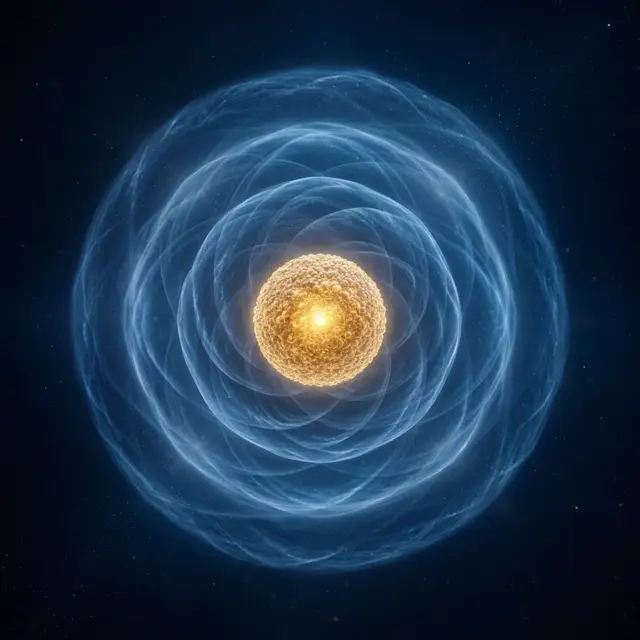
Between 1908 and 1913, Ernest Rutherford and his colleagues Hans Geiger and Ernest Marsden fired a beam of alpha particles at thin metal foils. The results forced Rutherford to a startling conclusion: the atom's positive charge is packed into a tiny volume at its centre, with electrons surrounding it in a diffuse cloud. That tiny centre is the nucleus.
In 1919 Rutherford went further. He bombarded nitrogen gas with alpha particles and detected hydrogen ions flying out. He had split nitrogen nuclei, and in doing so identified the hydrogen nucleus as a single positively charged particle.
Count the Protons, Name the Element
Every atom has a nucleus of protons and usually neutrons, wrapped in electrons. More than 99.94% of an atom's mass sits in that nucleus. Protons carry a positive charge, neutrons carry none, and electrons carry a negative charge, which is what holds them in place.
The number of protons is everything. Any atom with 11 protons is sodium. Any atom with 29 is copper. Atoms of one element with different numbers of neutrons are called isotopes. When protons and electrons are unequal, the atom becomes an ion: an anion if it has extra electrons, a cation if it is short of them.
Inside the nucleus, the nuclear force usually beats the electromagnetic push between protons. When it does not, the nucleus splits and leaves different elements behind. And when atoms link up through chemical bonds, they form molecules and crystals, which is where the whole science of chemistry begins.