When the Sun Touches the Sky
An aurora begins 150 million kilometers away. The Sun constantly sheds a stream of charged particles — the solar wind, rushing past Earth at around 400 kilometers per second. Our planet's magnetosphere, the vast magnetic bubble that shields us, deflects most of it. But during solar disturbances, magnetic field lines snap and reconnect, hurling electrons and protons down into the upper atmosphere.
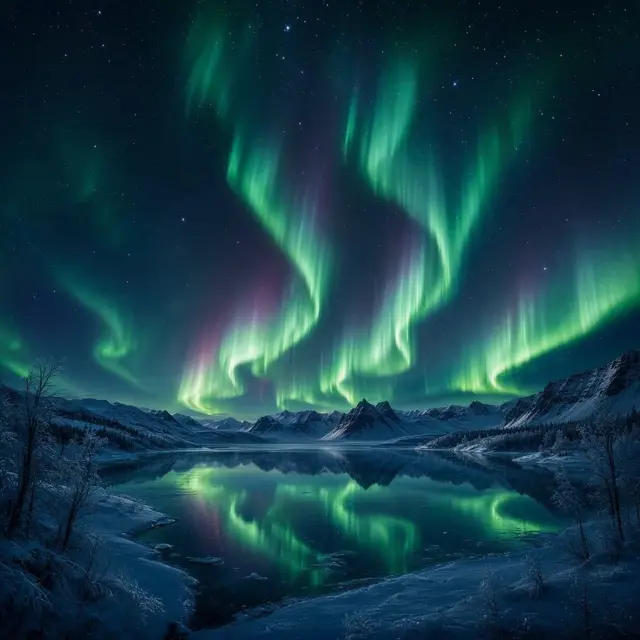
There, at altitudes of 80 kilometers and up, the particles slam into oxygen and nitrogen atoms and excite them. As the atoms relax, they release the extra energy as light — curtains, rays, spirals, and flickers dancing across the sky. In the north the display is called the aurora borealis; around the South Pole, the aurora australis. The two are mirror images, changing simultaneously on opposite ends of the Earth.
A Color Code Written in Altitude
Auroral colors are chemistry at specific heights. The classic green — the most common color — comes from atomic oxygen around 100 kilometers up. Rare, blood-red curtains at the highest altitudes are also oxygen, while blues and purples lower down come from nitrogen. Pinks and whites are mixtures.
There's a lovely quirk in the physics: oxygen's emissions are "forbidden transitions" — slow processes taking 0.7 seconds for green light and up to two minutes for red. The atom can only finish its glow if nothing bumps into it first, which is why those colors need the thin, quiet air of extreme altitude. Scientists have also catalogued a strange auroral cousin nicknamed STEVE: a narrow 25-kilometer ribbon of hot plasma at 450 kilometers altitude, blazing at 3,000°C and flowing at 6 kilometers per second.
The Night the Sky Went Electric
Auroras normally hug the polar regions — a band about 660 kilometers wide centered near 67 degrees latitude, best seen around the peak of the Sun's 11-year activity cycle. But when the Sun erupts violently, the auroral oval swells toward the equator. During the solar storms of May 2024, auroras were spotted as far south as Ferdows, Iran.
Nothing compares to the Carrington Event of 1859, the most spectacular auroral display ever recorded. In Boston, the sky at one o'clock in the morning glowed brightly enough to read ordinary print by. The accompanying geomagnetic storm surged through 125,000 miles of telegraph lines — yet some operators discovered they could disconnect their batteries entirely and keep sending messages on auroral current alone. A Japanese diary from 1770, rediscovered in 2017, hints at a storm that may have been even larger.
Not Just an Earth Thing
The name aurora comes from the Roman goddess of dawn — Galileo used "aurora borealis" in 1619 — but humans were recording the lights long before: the earliest known written account traces to roughly 2600 BC in China. Aboriginal Australian peoples associated the glow with fire, and the Māori of New Zealand called the southern lights great torches in the sky. Observers through history have even reported faint crackling sounds during strong displays — a phenomenon linked to charged particles in a cold night's atmospheric inversion layer, and still scientifically disputed.
And Earth holds no monopoly. Jupiter's auroras are fed partly by plasma from its volcanic moon Io; Saturn's are driven by the solar wind; Mars has shown a local aurora; and magnetless Venus produces diffuse patches of night-side glow. Far beyond the Solar System, astronomers found a brown dwarf whose auroras shine a million times brighter than our northern lights.