The Loophole in a Divided City
After World War II, Europe was split by what became known as the Iron Curtain, and Germany was divided in two. East Germany became a communist state. The city of Berlin sat deep inside East Germany, but it was divided too, and West Berlin was an island of the West.
That created a loophole. The main border between the two Germanys was closed in 1952, but Berlin was run by four occupying powers, so it stayed open. People could simply cross from East Berlin into West Berlin, then travel on to West Germany.
Huge numbers did. By 1961, about 3.5 million East Germans had left, around 20 percent of the entire population. Many were young and skilled, a loss known as a brain drain.
On 15 June 1961, East German leader Walter Ulbricht told an international press conference that no one had any intention of building a wall. Less than two months later, they built one.
Barbed Wire Sunday
On 12 August 1961, East German leaders signed the order to close the border. At midnight, police and soldiers moved in. By the morning of Sunday 13 August, West Berlin was sealed off. Workers tore up streets and put up barbed wire and fences. Germans came to call it Barbed Wire Sunday.
Within days, the first concrete blocks went in. Families were split overnight, and East Berliners who worked in the West were cut off from their jobs.
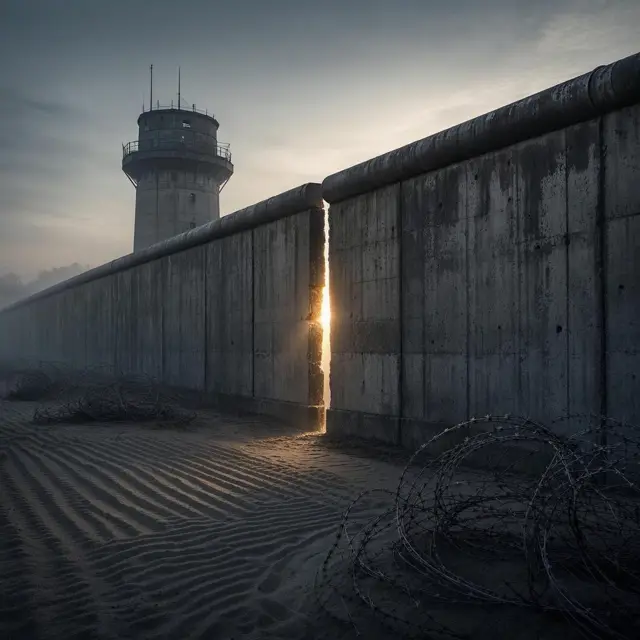
Over the years, the barrier grew into a deadly system more than 140 kilometres long. A second, inner wall created a wide death strip covered in raked sand, so footprints were easy to spot and guards had a clear line of fire. There were more than 116 watchtowers, trenches to stop vehicles, guard dogs and beds of nails.
The final version, finished around 1980, used 45,000 concrete sections, each 3.6 metres high, with a smooth pipe along the top to make it hard to climb.
Tunnels, Balloons and Sports Cars
People found clever ways out. Around 5,000 escaped to West Berlin while the Wall stood. Just two days after the border closed, a young border guard named Conrad Schumann jumped over the barbed wire himself.
Escapees dug tunnels, slid along wires strung high above the ground, and flew over in homemade hot air balloons and light aircraft. At least 70 tunnels were dug, and 19 of them worked, helping about 400 people escape. In one case, people drove a low sports car under the barrier at a checkpoint, with the roof and windscreen built to break away. So the guards built zigzag roads.
The cost was high. Guards had orders to shoot, and at least 140 people died because of the Wall. The last person shot while trying to cross was killed in February 1989, just months before it fell.
West Berlin's mayor, Willy Brandt, called it the Wall of Shame. East Germany officially called it the Anti-Fascist Protection Rampart.
The Mistake That Opened the Gates
By 1989, change was sweeping Eastern Europe. Hungary opened its border with Austria, thousands of East Germans fled that way, and huge peaceful protests spread across East Germany. On 4 November, half a million people gathered in East Berlin to demand change.
On 9 November, the government decided to let people cross the border, starting the next day. But the spokesman chosen to announce it, Günter Schabowski, had not been fully briefed. At a press conference, a reporter asked when the new rules would take effect. After a pause, Schabowski answered that, as far as he knew, it was immediately, without delay.
The news went out on West German TV, which East Germans could watch. Crowds rushed to the checkpoints. The guards had no orders and were hugely outnumbered. At 10:45 in the evening, the commander at Bornholmer Straße gave in and opened the gate.
East Berliners poured through to cheers, flowers and champagne, and people climbed on top of the Wall. Today, only a few stretches of it remain standing.