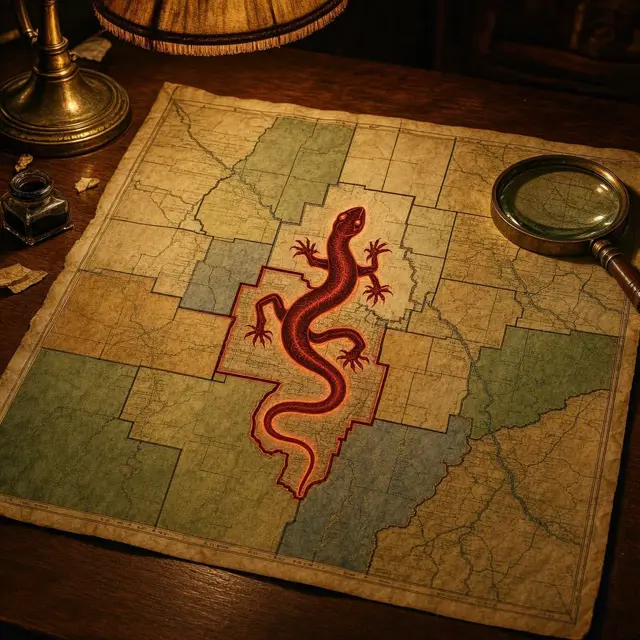
The Governor and the Salamander
In March 1812, Massachusetts Governor Elbridge Gerry signed a redistricting law that twisted one Boston-area voting district into a shape so contorted it reminded observers of a mythological salamander. A political cartoon — likely drawn by painter Elkanah Tisdale — gave the creature wings and claws, and Federalist newspaper editors at the *Boston Gazette* fused the governor's name with the beast: the "Gerry-mander" was born.
Gerry went on to become Vice President of the United States; his name went on to become a synonym for democratic manipulation. One historical irony survives in pronunciation: Gerry said his name with a hard G, like "get" — and the residents of his hometown of Marblehead still say it that way — but the world settled on the soft G of "gentle".
Cracking and Packing
Gerrymandering runs on two elegant, ruthless moves. Cracking splits the opposing party's voters across many districts, so they form a powerless minority everywhere — a city's voters scattered among suburban districts they can never win. Packing does the reverse: cramming opponents into one district they win overwhelmingly, wasting their surplus votes while the mapmaker's party comfortably takes everything around it.
The toolkit extends further — "hijacking" merges two districts to force rival incumbents into a duel, while "kidnapping" redraws an incumbent's home into hostile territory. Professor Wayne Dawkins captured the whole enterprise in one line: it is "politicians picking their voters instead of voters picking their politicians."
When Losing the Vote Wins the Election
The arithmetic can turn democracy on its head. In Pennsylvania's 2012 congressional elections, Democratic candidates won 83,000 more votes than Republicans — and lost 13 of the state's 18 seats, courtesy of a Republican-drawn map. Wisconsin's 2011 map converted 48.6% of the vote into 61% of the districts. In 1962, a party in the Bahamas won 44% of votes and only 8 of 33 seats, while its rival took 18 seats with 36%.
Australia's Queensland produced its own dialect of the trick — the "Bjelkemander", where rural districts needed only half the voters of urban ones, letting Premier Joh Bjelke-Petersen's party rule from 1986 with under 40% of the vote. And safe districts breed a quieter rot: in the 2002 US congressional elections, only four challengers in the entire country managed to defeat sitting incumbents — the lowest number in modern American history.
Can Math Fix It?
Plenty of democracies have simply engineered the problem away. The United Kingdom hands map-drawing to neutral boundary commissions; Australia uses a non-partisan electoral commission. Israel, the Netherlands, and Slovakia elect their parliaments from a single nationwide district — nothing to gerrymander. Proportional representation systems make the trick largely obsolete.
Reformers elsewhere reach for algorithms: the "shortest splitline" method recursively slices a state along the shortest possible lines into equal populations, producing clean, computer-drawn districts immune to political creativity. Iowa entrusts its maps to a nonpartisan bureau forbidden from even looking at political data. There's even a scheme borrowed from playground cake-cutting — "I-cut-you-choose" — that pits rival parties against each other's greed. The salamander, two centuries old, remains remarkably hard to kill.