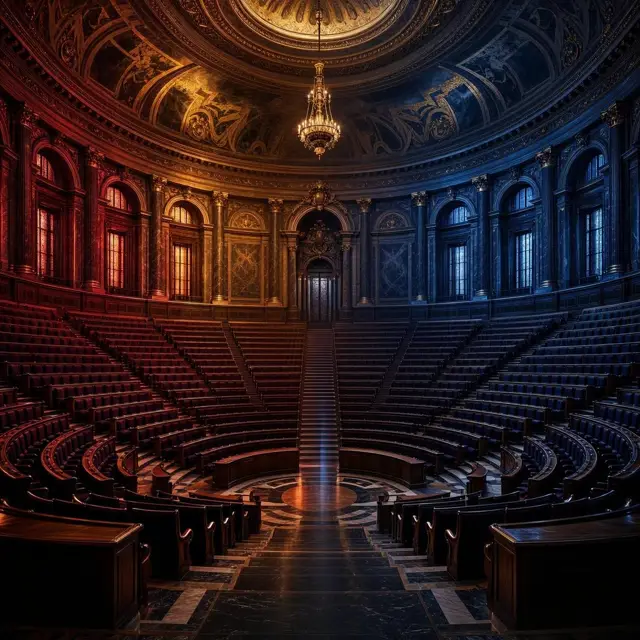
From Pirates to Parliaments
The word filibuster began at sea. It descends from the Dutch *vrijbuiter* — "freebooter", a plundering adventurer — sailing through French as *flibustier* and Spanish as *filibustero* before docking in English in the 1850s. It first described lawless military adventurers in Latin America; only later did it come to mean a different kind of hijacking — seizing a legislature's time.
The tactic itself is far older than the word. Its first recorded master was Cato the Younger of Rome, who exploited a Senate rule that all business must end by dusk. When Julius Caesar pushed a land-reform bill in 59 BCE, Cato simply talked until sunset, again and again, until Caesar gave up on the Senate entirely and took his law to a popular assembly instead. Obstruction by oratory has been infuriating the powerful ever since.
Talking a Bill to Death
In its most famous arena, the United States Senate, the mechanics are brutally simple: a senator may speak for as long as they wish, on any topic whatsoever. Debate ends only when cloture is invoked — which requires three-fifths of the chamber, typically 60 of 100 senators. Since 1975, that 60-vote threshold has meant most major legislation effectively needs a supermajority, not a simple majority, to pass.
The escape hatch has a suitably apocalyptic name: the nuclear option, by which a bare majority rewrites Senate precedent to bypass the filibuster. It was detonated in 2013 and again in 2017 — but only for confirming judges and officials. For ordinary laws the wall still stands: as recently as January 2022, an attempt to change the rules failed 52–48. Notably, only 14 US state legislatures still permit the practice at all.
Marathon Mouths Around the World
The filibuster is a global sport with heroic endurance records:
- South Korea, 2016: lawmakers relayed a 193-hour filibuster — eight straight days — against an anti-terrorism bill.
- Canada, 2011: a 58-hour marathon against postal legislation.
- Austria, 2010: Werner Kogler spoke for 12 hours and 42 minutes.
- Texas, 1977: state senator Bill Meier talked for a staggering 43 hours, famously equipped with an "astronaut bag" so he never had to leave the floor.
- France, 2006: the opposition skipped speeches entirely and filed 137,449 amendments to a privatization bill — voting on all of them would have taken ten years.
Even the 19th century played: Irish nationalists Joseph Biggar and Charles Stewart Parnell ground the British House of Commons to a halt in 1874. Where there are rules, there are people who read them very, very slowly.
Guardian of Minorities or Enemy of Majorities?
The filibuster's defenders call it the last brake protecting political minorities: it forces broad consensus, cools legislative fevers, and stops slim majorities from steamrolling half a country. Its critics call it minority rule in disguise — a procedural veto that lets a losing faction strangle laws most voters want, fueling the gridlock that makes citizens despair of politics.
Both sides are describing the same machine. A supermajority requirement is simply power handed to whoever wants to say no. That is why the fights over the filibuster are always fiercer than the fights it interrupts: the rule decides not one law but *all* laws. Cato would have understood perfectly — he wasn't defending debate. He was using the clock as a weapon, and the clock has never stopped being one.