Living Light, Invented 94 Times
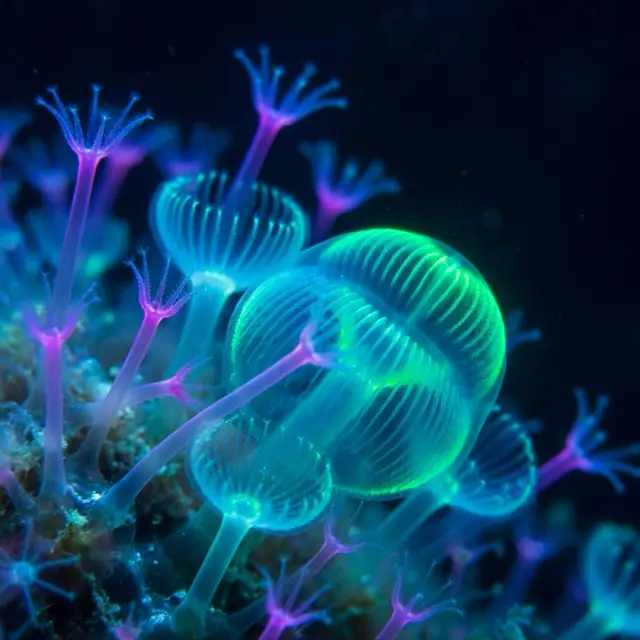
Here's something evolution apparently couldn't resist: bioluminescence, the ability of living things to make their own light, has evolved independently at least 94 separate times — first appearing in octocorals around 540 million years ago.
It's everywhere once you look. About 1,500 fish species glow, and in parts of the eastern Pacific deep sea, roughly 76% of the main animal groups can produce light. The glow comes from chemiluminescence — light born purely from a chemical reaction, with almost no heat.
The Chemistry Set Inside
The basic recipe is simple: a light-emitting molecule called luciferin reacts with an enzyme called luciferase, and the result is a cool glow. Some animals skip the enzyme and use a photoprotein like aequorin that lights up when calcium is present.
One luciferin, coelenterazine, turns up in 11 different animal phyla — and many creatures don't even make it themselves, but get it from their food. Bacteria coordinate their glow through quorum sensing, switching the lights on only once enough of them have gathered.
Why Glow at All?
Animals use their light for clever reasons. Counterillumination lets a creature match the dim light from above so it vanishes when seen from below. Others use light to attract mates, lure prey, startle predators, or signal.
Fireflies run two systems — females flashing from the ground to call males, or males signaling in flight. A few deep-sea barbeled dragonfishes even emit rare red light, a private channel most other animals can't see.
From Coal Mines to Storefronts
People have borrowed the glow for centuries. Before electric safety lamps, dried fish skins were used as a weak, flame-free light source in British and European coal mines, and during World War II the Japanese army dried 'sea-firefly' organisms for light.
The science paid off big: Osamu Shimomura and two colleagues shared the 2008 Nobel Prize in Chemistry for green fluorescent protein. And in 2016 a French company, Glowee, began selling bioluminescent lighting for shop fronts using glowing bacteria.