Life Worked Out Light Long Before We Did
Evolution does not usually repeat itself. Bioluminescence is the loud exception: living things have invented the ability to make their own light independently at least 94 times, first appearing in octocorals some 540 million years ago.
It is far more common than most people assume, and the further you go from the shore the more normal it becomes. In coastal marine habitats only about 2.5% of organisms are estimated to glow. In the open waters of the eastern Pacific, about 76% of the main groups of deep-sea animals have been found capable of producing light. More than 700 animal genera have been recorded with light-producing species.
Most of that light sits in the blue and green part of the spectrum, which travels best through seawater. There are oddballs, though. Some loose-jawed fish emit red and infrared light, and the worm genus *Tomopteris* emits yellow.
Two Chemicals, One Cold Flame
Almost every glow in nature runs on the same basic recipe. A light-emitting molecule called luciferin meets an enzyme called luciferase, which drives the oxidation of the luciferin. That produces an excited form of oxyluciferin, and as it drops back down to its ground state it releases visible light.
These are generic names rather than single substances, so scientists label them by species: firefly luciferin, cypridina luciferin, and so on. In some species the luciferase needs help from other cofactors, such as calcium or magnesium ions, and sometimes the energy-carrying molecule ATP.
Curiously, the luciferins barely vary. One in particular, coelenterazine, turns up in 11 different animal phyla, though some of those animals simply get it from their diet rather than making it. The luciferases, by contrast, differ enormously between species, which is part of why researchers concluded the trick was invented over and over rather than inherited once.
Glowing to Hide, to Hunt and to Flirt
The most elegant use is disappearing. In counterillumination camouflage, a deep-sea animal lights its own underside to match the dim light filtering down from above, so a predator looking up sees nothing but water. Photoreceptors control the brightness to match the background. In the squid *Euprymna scolopes*, the glowing bacteria are an integral part of the animal's own light organ.
Others use light offensively. The cirrate octopod *Stauroteuthis syrtensis* glows from structures that evolved from suckers, positioned within reach of its mouth, which suggests it lures prey straight in. Larvae of the click beetle *Pyrophorus nyctophanus* live in the surface of Brazilian termite mounds and light them up with a greenish glow that attracts the flying insects they eat.
And plenty of it is romance or panic. Fireflies signal for mates, with females glowing to attract males in some species and flying males signalling in others. Squid and small crustaceans squirt luminous clouds the way other squid squirt ink. The deep sea squid *Octopoteuthis deletron* can shed glowing pieces of its own arms, which keep twitching and flashing while the animal slips away.
From Darwin's Glowing Sea to a Nobel Prize
People have been puzzled by this for a very long time. Both Aristotle and Pliny the Elder mentioned that damp wood sometimes gives off a glow. Centuries later Robert Boyle showed that air was required, in wood, in fish and in glowworms alike.
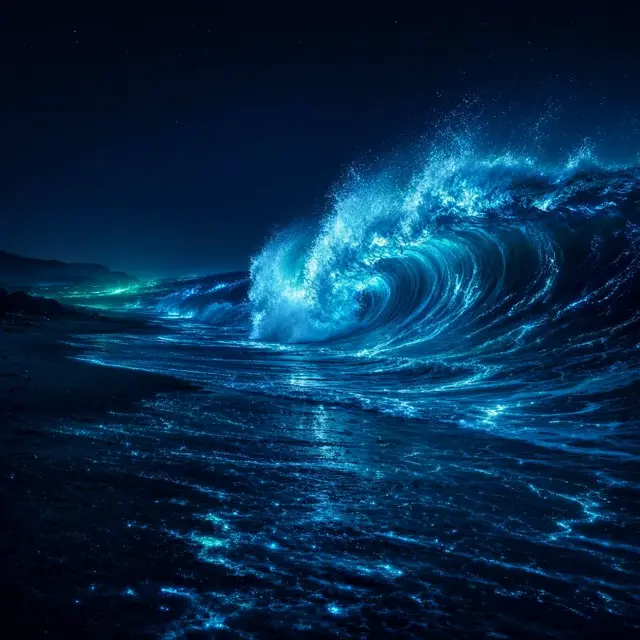
Charles Darwin watched it happen at sea and wrote that the vessel "drove before her bows two billows of liquid phosphorus, and in her wake she was followed by a milky train." He then guessed the cause was "a disturbed electrical condition of the atmosphere", which was wrong.
The real chemistry came from the French pharmacologist Raphaël Dubois, who showed the process involved the oxidation of a specific compound he named luciferin. The young Japanese chemist Osamu Shimomura was the first to obtain crystalline luciferin, using the sea firefly *Vargula hilgendorfii*, publishing the structure in 1957. Shimomura, Martin Chalfie and Roger Y. Tsien later shared the 2008 Nobel Prize in Chemistry for green fluorescent protein, now one of the most useful tools in biology.