The Swallows Everyone Thought Were Hibernating
For centuries, smart people believed swallows simply hid for the winter. The ancient Greek thinker Aristotle suggested that swallows and other birds hibernated. The idea stuck around for a surprisingly long time. As late as 1878, the naturalist Elliott Coues listed no fewer than 182 papers about swallows supposedly hibernating.
Part of the confusion came from where swallows sleep. Once they start to gather, they often roost at night beside rivers and ponds. People saw this and wrongly guessed the birds went into the water for the winter. Aristotle did get some things right, though. He recorded cranes travelling from the steppes of Scythia to marshes at the head of the Nile.
Only at the end of the 18th century was migration accepted as the real reason birds vanished from the north each winter. A 1797 book on British birds by Thomas Bewick even quoted a ship's master who saw great numbers of swallows flying north between Menorca and Majorca.
Record Breakers of the Sky
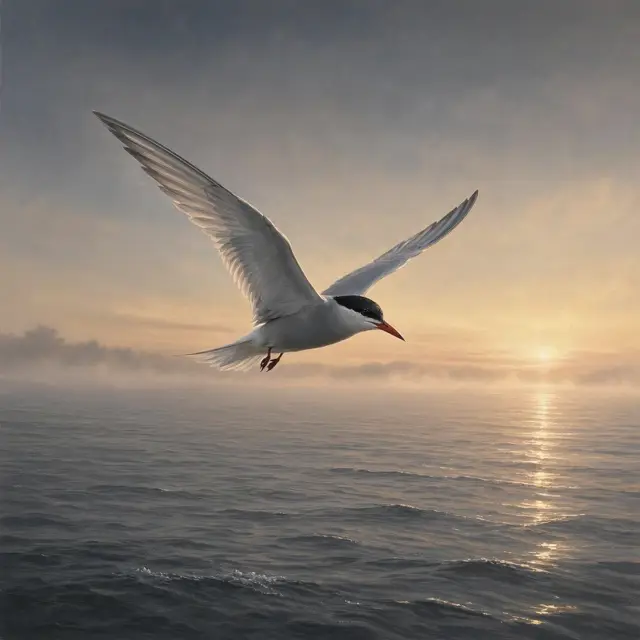
The Arctic tern makes the longest migration of any bird. It flies from its Arctic breeding grounds to the Antarctic, and it sees more daylight than any other bird. One tern from the Farne Islands, off the British east coast, carried a tiny light-sensing tag. In just 10 months it covered 96,000 km, travelling the length of the Atlantic, the width of the Indian Ocean and halfway across the South Pacific.
For non-stop flying, bar-tailed godwits win. Some fly 11,000 km from Alaska to New Zealand in one go, the longest known non-stop flight of any migrant. Before leaving, 55 percent of their body weight is stored as fat. Great snipes are impressive too, flying 4,000 to 7,000 km non-stop over 60 to 90 hours.
Then there are lifetime totals. Manx shearwaters live a long time, and one record-breaking bird is calculated to have flown 8 million kilometres during a life of more than 50 years.
High Fliers, Walkers and Swimmers
Flying together saves effort. Geese in a V formation may save 12 to 20 percent of the energy they would need to fly alone. Radar studies found that red knots and dunlins fly 5 km/h faster in flocks than on their own. Many birds also follow a set route called a flyway, which often traces mountain ranges, coastlines or rivers.
Some birds go shockingly high. GPS tracking recorded bar-headed geese flying at up to 6,540 m while crossing the Himalayas. Seabirds fly low over water but climb when crossing land, while land birds do the reverse. Still, most migration happens between 150 and 600 m up.
Migration is not only for fliers. Most penguin species migrate by swimming, on routes that can cover over 1,000 km. Dusky grouse move up and down mountains mostly by walking. In Australia, emus have been seen making long trips on foot during droughts.
A Built-In Calendar and Compass
Before migrating, many birds become restless, a behaviour known as Zugunruhe. It was first described in 1795. Even birds raised in cages, with no hints from the weather or shortening days, show it. Caged birds even prefer to face the direction their wild relatives would be flying, and they switch direction at roughly the same time.
To find their way, birds use the Sun, the stars, landmarks and even smells. They can also sense Earth's magnetic field, an ability called magnetoreception. A young bird on its first trip flies in the right direction using the field, but it does not know how far the journey will be. A nerve link between the eye and a part of the forebrain that is active during migration suggests birds may actually be able to see the magnetic field.
Experience matters too. Satellite tracking showed that older ospreys and honey buzzards are better than younger birds at correcting for wind drift.
Moon Watching and Flooded Rice Fields
Scientists have studied migration in clever ways. One older method is to point a telescope at the full moon at night and count the flocks flying across its face. Another uses microphones aimed at the sky to record the short calls flocks make while flying at night. Swans in England have been marked with a nick on the beak since about 1560, and scientific ringing began in 1899.
Migrants also need rest stops along the way, known as stopover sites. California's Central Valley was once a huge one, before it was turned into farmland. Now farmers in the United States flood their fields in winter to create temporary wetlands. Flooded rice paddies have proved important for at least 169 bird species.
Everyone wins. The birds get food and a safe place to rest, and they help break down leftover plant matter and fertilize the fields. That cuts the farmers' need for artificial fertilizer by at least 13 percent.