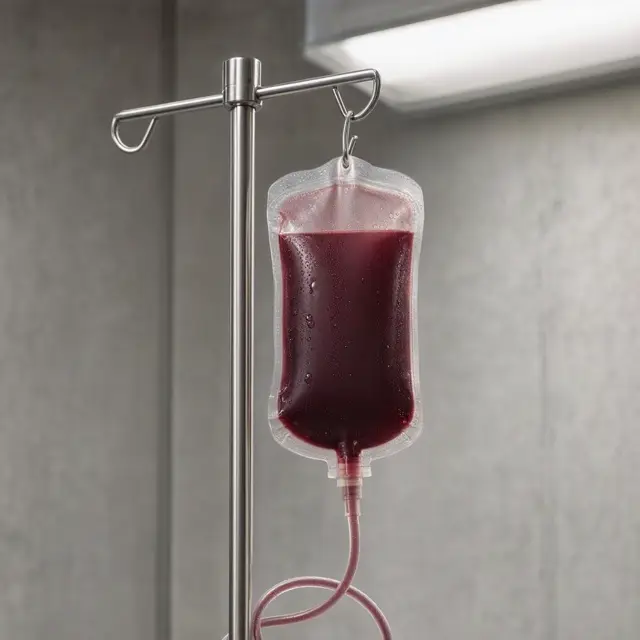
Sheep's Blood Into a Fifteen-Year-Old
The early history of transfusion is a sequence of experiments that should not be repeated. Richard Lower performed the first animal-to-animal transfusion in 1665 at the Royal Society.
Then Jean-Baptiste Denys, physician to King Louis XIV, performed the first animal-to-human transfusion on 15 June 1667, transferring sheep's blood into a 15-year-old boy. The boy survived. Denys tried again with others, and some of them died.
The reaction was swift and international. In 1668 both the Royal Society and the French government banned the procedure, and the Vatican condemned it in 1670. The ban was medically correct for entirely unknown reasons — nobody had any idea why some patients lived and others died, because before the components of blood were understood, doctors believed blood was homogeneous, the same substance in everyone. Because of that misunderstanding, many patients died from incompatible blood.
One Obstetrician, Ten Attempts
Human-to-human transfusion arrived a century and a half later. James Blundell, a British obstetrician, achieved the first successful transfusion of human blood in 1818, treating postpartum haemorrhage at Guy's Hospital in London.
His results tell you exactly how uncertain the practice still was. Between 1825 and 1830 he performed 10 transfusions, with five beneficial outcomes. A coin flip, in the era before anaesthesia.
The missing piece arrived in 1901, when Karl Landsteiner identified three blood groups — O, A and B — and finally explained why incompatible blood triggers a dangerous immune reaction. That single discovery converted transfusion from a gamble into a procedure. He received the Nobel Prize in Physiology or Medicine in 1930. Today O-negative serves as the universal donor type for emergencies.
The Problem of Blood That Clots
Knowing which blood to use solved half the problem. The other half was that blood outside a body clots almost immediately, which meant donor and recipient had to be in the same room at the same time.
Sodium citrate solved it. Albert Hustin in Belgium performed the first non-direct transfusion on 27 March 1914 using citrate, and Luis Agote in Argentina achieved the same in November 1914 with a less diluted solution.
Storage followed immediately. Francis Peyton Rous and Joseph R. Turner at Rockefeller University found that sodium citrate with glucose preserved blood for up to four weeks, reported in February 1915, and their June 1915 report established compatibility testing methods. Oswald Hope Robertson set up the first blood banks in 1917 for First World War casualties, and Percy Lane Oliver of the British Red Cross established the world's first blood-donor service in 1921 — by 1925 the London service was supplying nearly 500 patients.
Not Blood, but Parts of It
Modern transfusion rarely moves blood. It moves components.
Early transfusions used whole blood; today practice commonly uses only the specific part a patient needs:
- Red blood cells, which carry haemoglobin and deliver oxygen to the body's cells
- Plasma, the yellowish liquid that acts as a buffer and carries proteins and other essentials
- Platelets, which handle clotting and stop bleeding
- Other clotting factors
White blood cells are transfused only very rarely, since granulocyte transfusion has limited applications. Whole blood has recently come back into use in trauma settings.
The scale is enormous and the safety margins are now extraordinary. About 85 million units of red blood cells are transfused globally each year, stored at 1–6 °C with a shelf life of 42 days. Every donation is screened for HIV, hepatitis B and C, syphilis and other transmissible infections. Thanks to nucleic acid testing, HIV transmission now runs at roughly 1 in 3 million units, and hepatitis C at about 1 in 2 million.