A Poet's Disgust
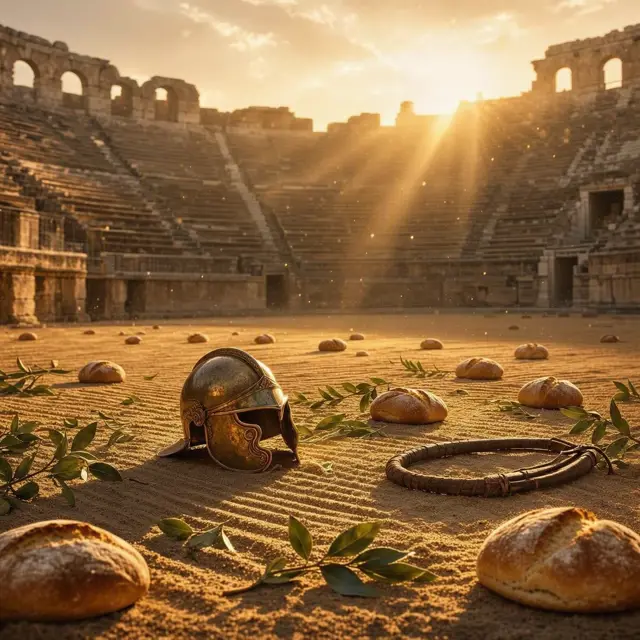
Around 100 CE, the Roman satirist Juvenal looked at his fellow citizens and despaired. These were the heirs of a republic — a people who had once handed out "military command, high civil office, legions" through their votes. Now, he wrote in his *Satire X*, they anxiously hoped for just two things: panem et circenses. Bread and circuses.
The line was not aimed at the emperors doing the distracting — it was aimed at the distracted. Juvenal was decrying what he saw as the people's own "selfishness": their willingness to abandon civic duty, their birthright of political participation, for a full stomach and an afternoon's entertainment. It is one of history's most quoted insults, and its target is the audience.
The Actual Bread, the Actual Circuses
Juvenal wasn't speaking in metaphors — both halves of the phrase were real imperial machinery. The Annona was Rome's grain dole: free wheat distributed to qualifying citizens of the capital. Emperor Augustus privately disapproved of the handouts on moral grounds — yet he maintained them anyway, and every emperor after him claimed personal credit for keeping the grain flowing. Feeding the city was simply too politically valuable to stop.
The circuses were the ludi — the public games. Costly spectacles and thundering chariot races filled Rome's venues, entertainment on an industrial scale offered free to the masses. Together, subsidized food and subsidized fun formed a complete political technology: a population that is fed and amused asks fewer questions of the people in charge.
The Oldest Trick in the Book
As a political concept, "bread and circuses" names a specific bargain: generating public approval not through excellent governance or wise policy, but through diversion — satisfying a population's most immediate appetites while its deeper interests go unattended. It is government by palliative: a treatment for the symptoms of discontent that carefully avoids curing its causes.
The phrase carries a double accusation. Rulers who deploy the strategy are cynics — but citizens who accept it are collaborators in their own sidelining. In Juvenal's framing, the deal signals a society where civic duty has eroded as a priority, where the habit of self-government has atrophied into the habit of consumption. The republic doesn't have to be taken from such a people; it has already been traded away.
Twenty Centuries Later, Still on the Menu
Few Latin phrases have aged so well — or so ominously. "Bread and circuses" remains a standing accusation in modern political argument, hurled whenever a government is suspected of substituting spectacle for substance: a flashy announcement here, a subsidy there, anything to keep the audience watching the show instead of the books.
Popular culture has returned the phrase to its Roman roots most famously in *The Hunger Games*, where a glittering capital rules its hungry districts through televised spectacle — and the nation itself is named Panem, straight from *panem et circenses*. Juvenal's complaint has become a permanent lens: every generation asks anew whether it is being governed — or merely entertained.