Why a Plant Would Start Hunting
Plants that eat animals sound like science fiction, yet there are at least 800 species of them. They grow on every continent except Antarctica. Most live in wet, sunny bogs where the soil is thin, acidic and very poor in nitrogen. If the ground will not feed you, you catch your food instead.
The trick is so useful that it has appeared again and again. True meat eating in plants is believed to have evolved on its own at least 12 times. That makes it a textbook case of convergent evolution: unrelated plants reaching the same answer separately.
Charles Darwin was hooked. He spent 16 years growing these plants in his greenhouse and published Insectivorous Plants in 1875. One neat way to sum them up comes straight from the science: carnivores are to nutrients what cacti are to water.
Five Ways to Catch a Meal
Carnivorous plants use five basic traps. Pitfall traps, like pitcher plants, are rolled leaves holding a pool of digestive juice. Flypaper traps coat their leaves in sticky glue called mucilage. Snap traps shut fast. Bladder traps suck prey in. Lobster-pot traps let prey in easily, then use inward-pointing hairs to push it toward a stomach.
The bladder trap is the sneakiest. A bladderwort pumps water out of a tiny bag, creating a partial vacuum inside. When a small water creature brushes the trigger hairs on its little door, the door gives way and the animal is sucked in.
Sundews are no slouches either. Their glue-tipped tentacles bend toward prey, and one species can fold its tentacles 180 degrees in about a minute. Some sundews depend on insects so much that they lack the enzyme most plants use to take nitrogen from soil.
The Trap That Counts to Two
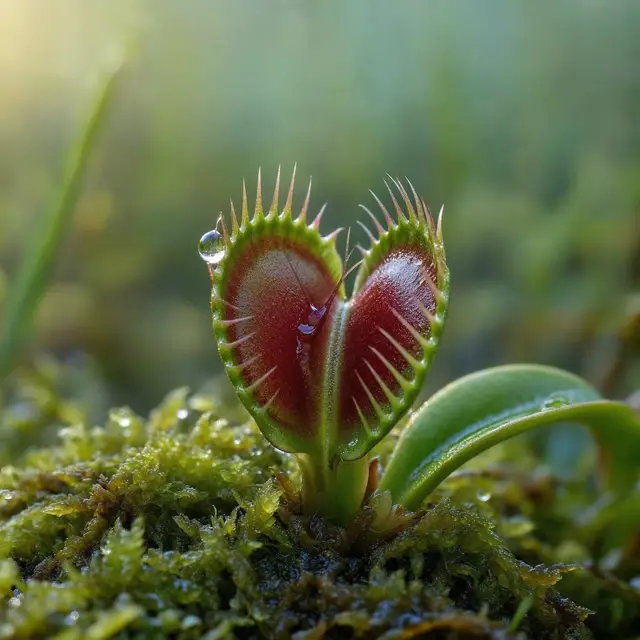
The Venus flytrap and its water-dwelling cousin, the waterwheel plant, are the only two active snap traps. Each trap is a leaf split into two hinged lobes. Inside, the flytrap has three trigger hairs on each lobe.
Bending a trigger hair sends an electrical signal called an action potential through the leaf. Cells in the middle of the leaf change shape, and the lobes, held under tension, flip from bulging out to curving in. The whole snap takes less than a second.
Here is the clever part. The flytrap has a simple memory. To close, it needs two touches between 0.5 and 30 seconds apart, so a raindrop or a bit of blown dust will not waste a trap. Once shut, the struggling insect makes it seal tighter, forming a stomach that digests for one to two weeks. A leaf can be reused three or four times before it stops responding.
Pitchers Full of Tricks
Pitcher plants lure insects with nectar and bright, flower-like patterns. The inside walls are often coated in loose waxy flakes, so visitors slip and tumble into the fluid below. One species, the yellow trumpet pitcher, even laces its nectar with a toxin also found in hemlock, which probably makes prey woozy.
Rain is a real problem in very wet places. The marsh pitcher plants of South America solved it with a small gap in the leaf edge that lets extra water drain out, much like the overflow hole in a bathroom sink.
The giant Nepenthes rajah has the strangest deal of all. Tree shrews and rats visit to lick sweet secretions from its lid, and they poop into the pitcher while they eat. This is a kind of mutualism, where both sides win. A small bat does something similar, roosting under the lid of another pitcher plant and paying rent with its droppings.
How Not to Kill Your Flytrap
Venus flytraps are the most commonly grown carnivorous plants, often sold at garden centers and hardware stores. They are also surprisingly easy to kill. Most carnivorous plants need rainwater or purified water. Ordinary tap water carries minerals, especially calcium salts, that build up and kill them. These plants are extreme calcifuges, used to poor, acidic soil.
Feeding them is another trap for owners. Outdoor plants usually catch plenty on their own. Bits of hamburger will simply rot, and that can kill the trap or even the whole plant. Besides tap water, the most common cause of flytrap death is people prodding the traps to watch them close.
In the wild, things are harder still. A 2020 assessment found that roughly one quarter of carnivorous plant species are threatened with extinction from human actions, mainly through habitat loss, plant collecting and pollution.