Colour Made by Tiny Crystals
When a chameleon changes colour, it is not simply mixing paint in its skin. Its skin holds several stacked layers of special cells. Near the top sit yellow and red cells. Below them is a layer of iridophores, cells packed with tiny see-through crystals. At the bottom are cells full of dark melanin.
The trick is in those crystals. When the chameleon is calm, they sit close together and reflect blue light. That blue passes through the yellow layer above it, and the result is the ordinary green we expect. When the chameleon gets excited, the spacing between the crystals changes. Now the skin can quickly reflect yellow, orange, red, or go back to blue.
Scientists still do not know exactly how chameleons move the crystals. The best guess is that signals from nerves or hormones set the change in motion.
Mostly It Is Not About Hiding
Most people think chameleons change colour to vanish into the leaves. They can, but the most common reasons are talking to other chameleons and handling the weather. A chameleon shows brighter colours when it is ready to fight and darker ones when it gives up.
Because chameleons are ectothermic, colour also works like a thermostat. Turning darker soaks up light and heat to warm the body. Turning lighter reflects heat away to cool it down.
Some species are even smarter about hiding. Smith's dwarf chameleon adjusts its camouflage depending on whether the threat is a bird or a snake. On Hawaii, where Jackson's chameleons were brought in and face fewer predators than back home in Kenya, they now use more showy colours for chatting and fewer colours for hiding. Forest chameleons also tend to be far more colourful than their brown desert cousins.
A Tongue That Launches at 41 g
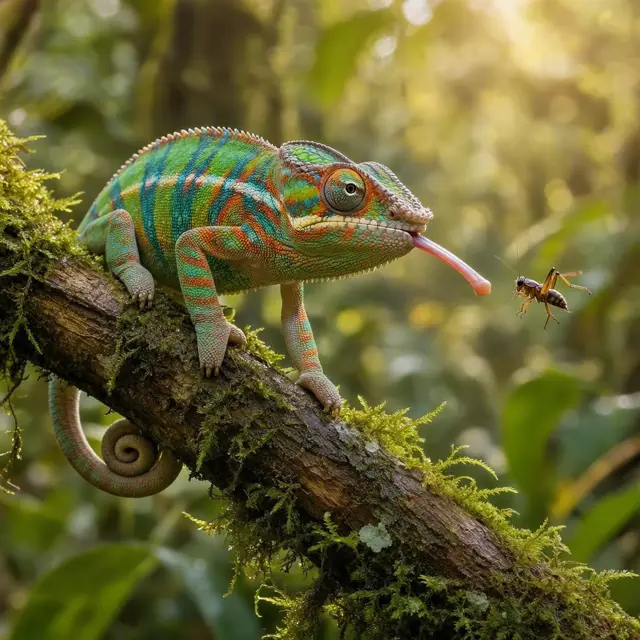
A chameleon's tongue is usually one and a half to two times the length of its body, not counting the tail. Smaller chameleons have even longer tongues for their size and can shoot them more than twice their body length.
The launch is wild. The tongue can reach prey in as little as 0.07 seconds, with an acceleration above 41 g. It releases more power than muscle alone can produce. The secret is a tube of muscle called the accelerator muscle, which squeezes and loads up stretchy tissue inside the tongue. That tissue then snaps back and flings the tongue forward.
This spring system has a lovely side effect. Most cold-blooded animals turn sluggish when it is chilly. Chameleons can still fire their tongues at full power on cold mornings, while other lizards nearby are not even moving yet. Pulling the tongue back is slower in the cold, but a sticky, suction-like grip holds the prey tight.
Two Eyes Watching Two Worlds
A chameleon's upper and lower eyelids are joined, leaving only a pinhole for the pupil. Each eye can swivel and focus on its own, so a chameleon can watch two different things at the same time. Together, the eyes cover a full 360-degree circle around the body. Its brain is constantly handling two separate pictures of the world.
Those eyes are also powerful. For their size, chameleons have the highest magnification of any animal with a backbone. They can see ultraviolet light too. Under ultraviolet light, they become more social and more active, and more likely to bask, eat and breed.
Their ears are a surprise of a different kind. Like snakes, chameleons have no outer or middle ear, so there is no ear hole and no eardrum. Yet they are not deaf. They can pick up low sounds between 200 and 600 Hz.
Glowing Bones and Tiny Giants
Some chameleons hide a secret light show. Their bones glow when hit by ultraviolet light, a trick called biogenic fluorescence. In 31 species of Calumma chameleons from Madagascar, the bones gave off a bright blue glow that shone right through the skin. On the face, it showed up as glowing dots. It may be a second signalling system that works alongside colour change.
Chameleons also come in amazing sizes. Males of Brookesia nana reach just 22 mm, making it one of the smallest reptiles in the world. Males of Furcifer oustaleti can reach 68.5 cm. Many tree-living species grip branches with a prehensile tail, so useful that it is often called a fifth limb.
People have puzzled over these animals for a long time. In Shakespeare's day, many believed chameleons lived on nothing but air.