The Worst Day in 66 Million Years
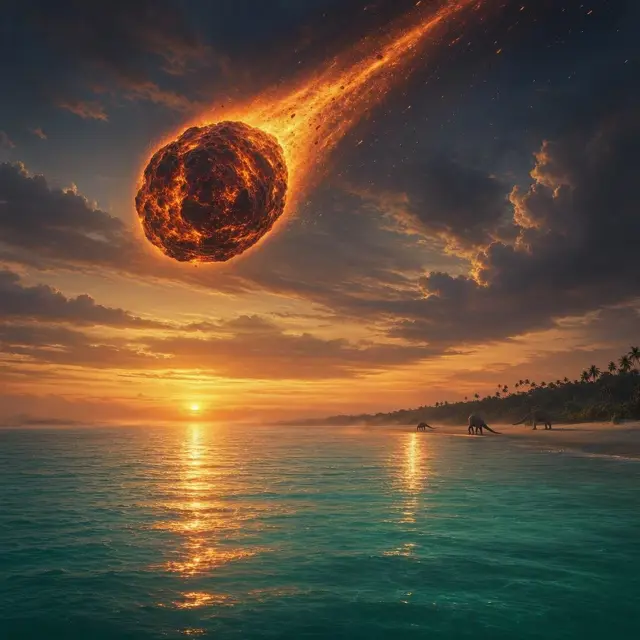
Slightly over 66 million years ago, an asteroid about 10 kilometers across — the size of a city — slammed into a shallow tropical sea at roughly 20 kilometers per second, striking at an angle of 45 to 60 degrees. The energy released is estimated in the tens of millions to billions of megatons of TNT.
The immediate violence defies imagination: winds beyond 1,000 kilometers per hour near the blast, an earthquake estimated at moment magnitude 9 to 11, and megatsunamis over 100 meters tall — with simulations suggesting the initial wave may have reached 1.5 kilometers in height. Around 25 trillion metric tons of material was blasted into the atmosphere, and the falling, re-heating debris ignited wildfires that swept through nearly 70% of the planet's forests.
An Unlucky Piece of Seafloor
The asteroid's landing spot made a catastrophe apocalyptic. The shallow seafloor it struck was rich in gypsum and anhydrite — sulfur-bearing rock. Vaporizing it flung vast amounts of sulfur into the sky, where it combined with dust to block sunlight for a decade or longer. Photosynthesis faltered, food chains collapsed from the bottom, and the planet plunged into an impact winter laced with acid rain. Had the rock struck deep ocean or different geology, the outcome might have been far less deadly.
The result was the Cretaceous–Paleogene extinction: 75% of all plant and animal species vanished, including every non-avian dinosaur. In New Jersey — 2,500 kilometers away — fossils record death and burial under debris that happened suddenly and quickly. One eerie detail from fossil fish bones: the asteroid struck in the Northern Hemisphere's spring.
Found by Accident, Ignored for a Decade
In 1978, geophysicists Glen Penfield and Antonio Camargo were hunting for oil off Mexico's Yucatán Peninsula for the state company Pemex when their magnetic and gravity maps revealed something strange: a shallow bullseye 180 kilometers across, centered near the village of Chicxulub. Penfield suspected a crater. Pemex attributed it to volcanic activity, and a 1981 conference presentation went largely unnoticed.
Meanwhile, physicist Luis Alvarez and his geologist son Walter had proposed that an impact killed the dinosaurs, based on a clay layer in Italy with iridium — an element rare on Earth but common in asteroids — at up to 160 times background levels. The two puzzle pieces floated separately until 1990, when a journalist connected researcher Alan Hildebrand with Penfield. Old Pemex drill cores stored in New Orleans yielded shocked quartz — rock deformed in ways only an impact can produce. The 1991 paper naming the crater closed the case, and a 2013 isotope study dated impact glass to almost exactly the extinction boundary.
The Scar Beneath the Beach Towns
Today the crater lies buried under about a kilometer of younger rock, straddling the Yucatán coastline. Its inner rim announces itself at the surface in an unexpected way: a great arc of cenotes — freshwater sinkholes — traces the buried ring, and that reliable water supply later made the region unusually hospitable to human settlement. The impact that ended one world quietly watered another.
Chicxulub is one of the largest impact structures on Earth, and the only one whose peak ring — the inner circle of mountains large craters form — is intact and directly accessible to science. In 2016, an ocean drilling expedition cored 1,335 meters into that ring and found pink granite hauled up from deep in the crust, plus evidence of a massive hydrothermal system that cooked 140,000 square kilometers of crust for hundreds of thousands of years — the kind of warm, chemical-rich environment some scientists think could seed life itself.