A Word That Once Meant a Lump of Rock
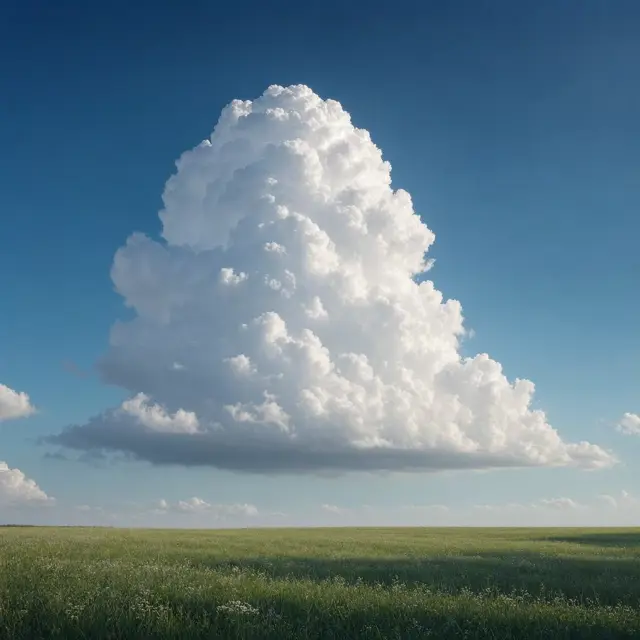
The word cloud once meant a lump of rock. In Old English, clud or clod described a hill or a mass of stone. Around the start of the 13th century, people began using it as a picture word for rain clouds, because a puffy heap of cloud looks a lot like a pile of rock. Over time it pushed out weolcan, the older word for clouds.
So what is a cloud, really? It is a visible mass of tiny liquid droplets, ice crystals or other particles floating in the air. On Earth, these are mostly water. The science of clouds even has its own name, nephology, and it sits inside the cloud physics branch of weather science.
Clouds are not just pretty. They can reflect sunlight back to space and cool the ground below, or trap heat rising from the surface and warm it. Scientists call clouds the main uncertainty in how sensitive our climate is to change.
Two Men, One Year, Two Ways to Name the Sky
In 1802, two men on either side of the English Channel set out to name the clouds. In England, Luke Howard was a careful observer who knew his Latin well. He believed that watching cloud shapes change could unlock the key to weather forecasting. In France, Jean-Baptiste Lamarck worked on the same problem that very year.
Lamarck chose informal French names, with 12 categories such as hazy clouds, dappled clouds and broom-like clouds. His system failed to catch on, even in France. Howard used Latin instead, and it spread quickly after he published it in 1803. The German poet Johann Wolfgang von Goethe was such a fan that he wrote four poems about clouds and dedicated them to Howard.
An expanded version of Howard's system was officially adopted in 1891. Today it sorts the lower sky into ten basic types, each called a genus, with names like cirrus, stratus and cumulus. Fog is simply a very low cloud that reaches the ground.
How Invisible Water Turns Into White Fluff
Every cloud starts as invisible water vapor. When air cools to its dew point, the temperature at which it becomes saturated, the vapor condenses into droplets. Those droplets need something to grab onto, usually tiny specks of salt or dust called cloud condensation nuclei.
What cools the air? Usually it is lift. Sunshine heats the ground and warm air rises. Weather fronts force air upward. Wind can also push air up the side of a mountain, a process called orographic lift. On rare occasions, rising air is so strong that a cloud top punches right into the stratosphere.
Why are clouds white? Deep, dense clouds reflect 70 to 95 percent of visible light. The droplets are packed so tightly that sunlight bounces back out before getting far inside. As droplets grow bigger and spread apart, more light gets absorbed, and the cloud turns gray or almost black. That is also why you can see farther in heavy rain than in heavy fog.
Clouds Made by Waterfalls, Forests and Planes
Cloud scientists have official names for some surprising cloud makers. Spray from a waterfall can create stratus cataractagenitus, Latin for cataract-made. Water vapor rising above a forest canopy can form silvagenitus, meaning forest-made. Trails from aircraft exhaust can spread into sheets known as cirrus homogenitus, or man-made cirrus. Large fires and volcanic eruptions build tall clouds called flammagenitus, and volcanic ones have reached 57 kilometres high.
Then there is the Morning Glory, a rolling tube of cloud that turns up without warning over the Gulf of Carpentaria in northern Australia. It rides a powerful ripple in the air, and glider pilots can surf it.
Some storm clouds even turn green or blue. That tint means the cloud holds huge amounts of water, hail or rain. It does not prove a storm is severe, but it confirms the potential. Other newly named features include asperitas, a chaotic wavy cloud base, and the flumen, nicknamed the beaver's tail.
Clouds Above the Weather and on Other Worlds
The highest clouds on Earth float about 80 to 85 kilometres up, near the top of the mesosphere. That is roughly ten times higher than ordinary high clouds. They are called noctilucent clouds because they shine well after sunset and before sunrise, usually bluish or silvery white. Evidence suggests that smoke particles from burnt-up meteors help them form. They have been showing up more often since the 19th century, possibly because of climate change.
A little lower, over the poles in winter, polar stratospheric clouds can shimmer with mother-of-pearl colors.
Other worlds have clouds too. Venus hides under three thick cloud layers between 45 and 65 kilometres up. Jupiter and Saturn have clouds of ammonia on top and water clouds deeper down. Uranus and Neptune have clouds made of methane, and Mars has clouds of water ice. In 2013, scientists even announced clouds on a planet beyond our Solar System, called Kepler-7b.