A War Without a Battle
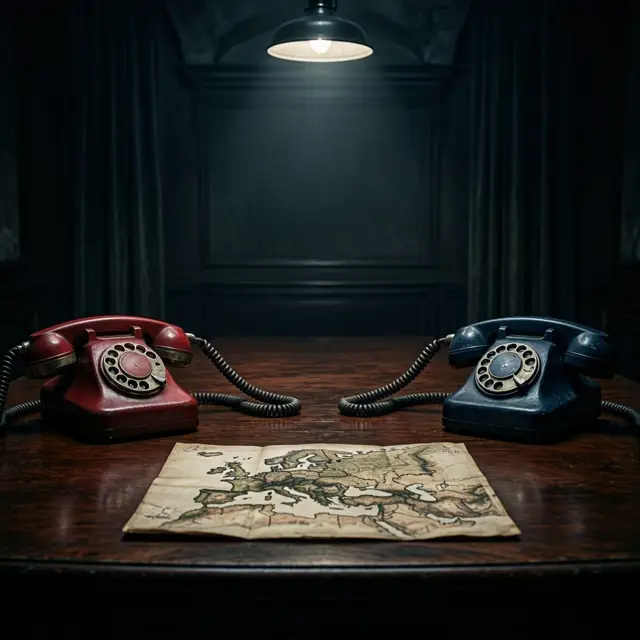
It lasted more than 40 years, split the world in two, and shaped almost everything from space travel to sport. Yet the two main rivals never fought a single battle against each other. That is exactly why it was called the Cold War.
On one side stood the United States and its allies, the Western Bloc. On the other stood the Soviet Union and its allies, the Eastern Bloc. They had been allies in World War II, but after 1945 they became deep rivals, each with a different idea of how a country should be run.
Instead of fighting head on, they competed through spying, propaganda, trade, sport and technology. They also backed opposite sides in other conflicts, known as proxy wars.
Where the Name Came From
The phrase "cold war" was used in 1945 by the writer George Orwell. In an essay about the atomic bomb, he imagined states locked in a permanent "cold war" with their neighbours.
The first person to use it for the rivalry between the US and the Soviet Union was Bernard Baruch, an adviser to American presidents. In a speech on 16 April 1947, he declared, "we are today in the midst of a cold war."
The journalist Walter Lippmann then made the term famous with his book The Cold War. When asked where the phrase came from, he traced it back to a French term from the 1930s, la guerre froide. Soon, Europe was split by what people called the Iron Curtain.
Candy From the Sky Over Berlin
One of the first big tests came in Berlin. After World War II, the city sat deep inside Soviet-controlled land, but its western half was run by the US, Britain and France.
In June 1948, the Soviet leader Joseph Stalin blocked all roads and railways into West Berlin, trying to cut off supplies. The West answered with the Berlin airlift, flying food and supplies into the city by plane, month after month.
One American pilot, Gail Halvorsen, started dropping candy for the city's children. The airlift was a huge success, both practical and emotional. In May 1949, Stalin lifted the blockade. Berlin would stay a flashpoint, and in 1961 the Berlin Wall went up to divide the city.
The Race to Space
The rivalry soon reached space. In October 1957, the Soviet Union launched Sputnik 1, the first satellite ever to orbit the Earth. The shock in the West was so big it became known as the Sputnik crisis.
That launch started the Space Race. Each side wanted to prove its science was the best. It led to milestone after milestone, most famously the American Moon landings from 1969. The astronaut Frank Borman later called the landing "just a battle in the Cold War."
Despite the competition, both countries signed treaties in the 1960s to limit weapons in space. Later, during a calmer period, they even worked together, linking an American Apollo capsule and a Soviet Soyuz craft in orbit.
The Closest Call
The most dangerous moment came in October 1962. The Soviet Union placed nuclear missiles on the island of Cuba, just off the coast of the US. President John F. Kennedy responded with a naval blockade and a firm warning.
After a tense standoff, the Soviet leader Nikita Khrushchev backed down and removed the missiles. In return, the US promised not to invade Cuba, and secretly agreed to remove its own missiles from Turkey.
The Cuban Missile Crisis brought the world closer to nuclear war than ever before. Afterwards, both sides worked harder to limit the arms race, and in the 1970s they signed treaties to cap their nuclear weapons.
How It Ended Without a Shot Between Them
In 1985, Mikhail Gorbachev became the Soviet leader. He opened up the economy and allowed more freedom of information, a policy called glasnost. He also moved to end the Cold War.
In 1989, he chose not to interfere as countries in Eastern Europe pushed for change. A peaceful chain reaction followed. In August, a picnic on the Hungarian border let thousands of East Germans cross to the West. Soon the Berlin Wall came down, and the Iron Curtain fell with it.
In 1991, the Soviet Union itself broke apart. After more than four decades, the Cold War was over, and the two superpowers had never fought each other directly.