The chemist who studied his own eyes
Color blindness is common, yet there are almost no early records of it. The first well-known case study came in a 1777 letter about "Harris the Shoemaker" and several of his brothers. Their condition would later be described as protanopia.
The real science began in 1794. English chemist John Dalton gave the first account of color blindness in a paper to a Manchester society, and his own vision was part of the story. Dalton also noticed that out of 25 pupils he once taught, 2 saw colors the way he did. That is about 8 percent, the same figure found today for men of Northern European ancestry.
The story has a remarkable ending. Dalton's eyeball was preserved. In 1995, some 150 years after his death, genetic analysis of it confirmed he had deuteranopia. Thanks to him, the common red-green form of color blindness is still called Daltonism.
Why men are hit so much harder
Color vision relies on three kinds of cone cells in the retina. Color blindness usually happens when one or more of them does not work normally. The most common form is red-green color blindness. It affects up to 1 in 12 males but only about 1 in 200 females.
The reason is the X chromosome. The genes behind red-green color blindness sit there. Males have one X chromosome, so a single affected gene is enough to make them color blind. Females have two. If only one is affected, the normal copy takes over and she sees colors normally. She is only color blind if both copies are affected. This pattern is called X-linked recessive inheritance.
Severity varies a lot. The mildest type, anomalous trichromacy, is about three times more common than dichromacy, and some people with it never even notice. In dichromacy, a person can match every color they see using just two primary colors instead of three. At the far end, monochromats see no color at all, only brightness.
Hidden numbers and balls of wool
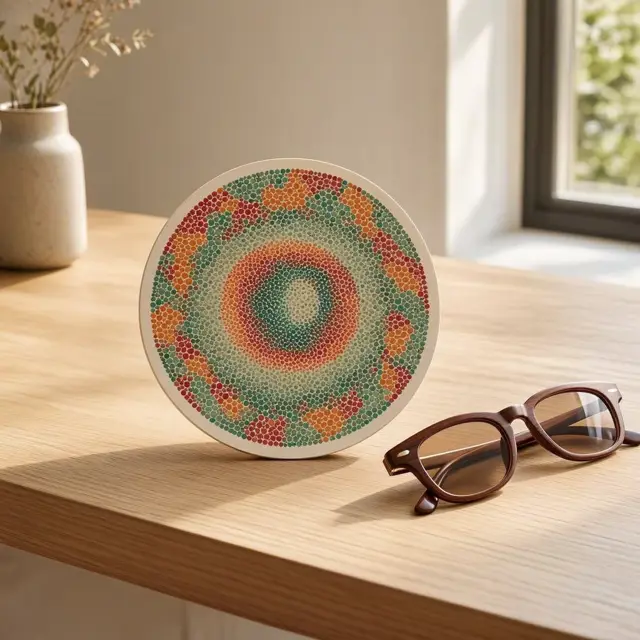
The best-known check is the Ishihara test. It belongs to a family called pseudoisochromatic plates. Each plate hides a figure made of spots, surrounded by spots of a slightly different color. To someone with normal color vision, the figure stands out. To a color blind person, the two sets of spots look the same. These plates are cheap, fast and simple, so they are great for screening, but they do not give a precise diagnosis.
Testing got serious after an 1875 train crash in Sweden. A physiologist, Alarik Frithiof Holmgren, concluded that the engineer's color blindness had caused it, although that claim has been questioned. He created the first color vision test using colored skeins of wool. It was meant to keep color blind people out of transport jobs that depend on safety signals.
Lantern tests show small red, green and yellow lights, and the person names each one. They do not diagnose color blindness. Instead, they check whether someone can safely do a specific job.
Bananas, traffic lights and snooker balls
Daily life is full of small color puzzles. Picking ripe bananas is hard, because the change from green to yellow is tough to spot. Spotting mold on food or a sunburn on someone's skin can be tricky too.
Traffic lights are a bigger challenge, so many color blind drivers memorize the position of each light. The order is standard: red, amber, green, from top to bottom or left to right. That makes one light in Syracuse, New York, stand out. The traffic light on Tipperary Hill is upside-down, with green on top, because of the feelings of the local Irish American community. In eastern Canada, some lights also use shapes: a square for red, a diamond for yellow and a circle for green.
Sport is affected too. Snooker world champions Mark Williams and Peter Ebdon sometimes ask the referee to help tell the red balls from the brown ones. Both have played foul shots by potting the wrong ball.
A surprising upside
Color blindness is not always a drawback. People with deuteranomaly, a mild type, can be better at telling apart shades of khaki and olive. In a 2005 study, they could tell apart 15 shades of khaki that people with normal color vision could not. They may also see through some camouflage. Some test plates even work in reverse, hiding digits that only color blind people can read.
It has not stopped great careers. Australian painter Clifton Pugh won the Archibald Prize three times and has been identified as having protanopia. Jin Kim became a character designer at Walt Disney Animation Studios despite his red-green color blindness.
There is no cure for most types. Special glasses can help with some tasks, but they do not give normal color vision or show "new" colors. Artist Neil Harbisson, who sees no color at all, took another path. A device called the eyeborg lets him hear colors as sounds, and it allowed him to start painting in color.