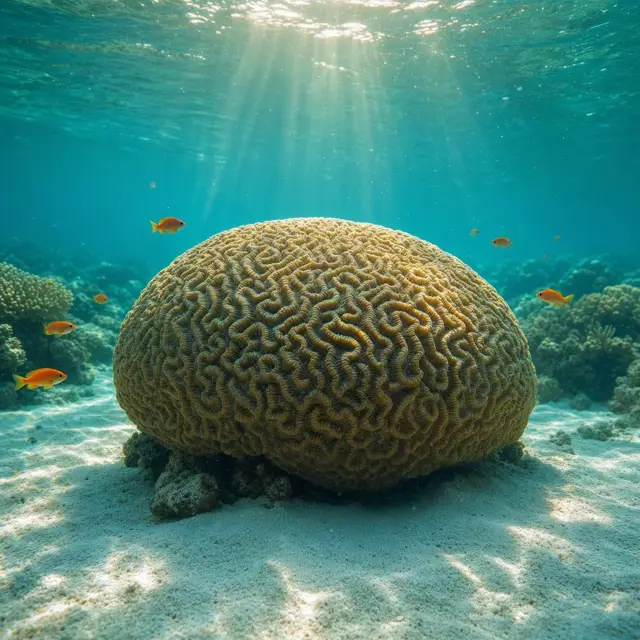
Rock Built by Tiny Animals
A coral reef looks like rock, but animals built it. Reefs are made of colonies of coral polyps, which belong to the same animal group as jellyfish and sea anemones. Unlike those soft cousins, corals build hard skeletons out of calcium carbonate. Each polyp lays this material down beneath and around itself, pushing the coral upward and outward.
Corals have been at this for a very long time. The first coral reefs appeared 485 million years ago. Yet most of today's reefs are less than 10,000 years old. They formed after the last ice age, when melting ice raised the sea and flooded the edges of the continents.
Growth is slow. A healthy tropical reef grows upward by 1 to 25 cm a year. It needs sunlight, so it only grows in water shallower than 150 m. Coral shapes are named after things on land, like wrinkled brains, cabbages, table tops and antlers.
Darwin's Sinking Volcano Idea
During his voyage on the Beagle, Charles Darwin came up with a bold idea about ring-shaped reefs. He said they start as a fringing reef around a volcanic island. As the island and the sea floor slowly sink, the coral keeps growing upward on a base of older, dead coral. In time, it becomes a barrier reef, with a lagoon between the reef and the land.
Finally, the island sinks below the sea. What remains is an atoll, a rough ring of living coral around a central lagoon. Darwin predicted that the old volcano's bedrock would sit under each lagoon, and later research backed him up. The entire Maldives is made of 26 atolls.
The Great Barrier Reef shows another path. About 20,000 years ago, the sea there was 120 m lower than today. As it rose, corals grew over old coastal hills. The reef stopped at the barrier stage, because Australia is not about to sink.
The Algae Living Inside
Here is the twist. Coral polyps cannot make food from sunlight. Instead, they host microscopic algae called zooxanthellae inside their tissues, about one million in every cubic centimetre of coral. The algae turn sunlight into sugars and other nutrients and share them. Corals get up to 90% of their nutrients this way.
In return, the coral gives the algae shelter and a steady supply of carbon dioxide. This is mutualism, a deal where both sides win. It is also why reefs grow much faster in clear, sunny water. Without their partners, corals would grow too slowly to build reefs at all.
The algae also give brown corals their color. When corals are stressed, they push the algae out and turn white. This is coral bleaching, and unless it is reversed, it can kill the coral. Still, reefs that live through a severe bleaching can become more resistant to the next one.
An Oasis in an Empty Sea
Tropical seas are poor in nutrients, which is partly why the water is so clear. Yet reefs burst with life there, like an oasis in the desert. This puzzle is called Darwin's paradox. Reefs cover less than 0.1% of the ocean, about half the area of France, but house at least 25% of all sea species, including over 4,000 kinds of fish.
Part of the answer is recycling. Reefs reuse nutrients far more than the open ocean does. Sponges living in reef cracks filter the water, and in the Red Sea they eat about 60% of the drifting plankton. Later they release nutrients that corals can use.
Even the rough coral surface helps. Normally a thin film of still water, called a boundary layer, clings to underwater objects and blocks food. Waves breaking on rough coral edges tear that film apart. That is why Darwin noticed the biggest, strongest corals growing where the surf was wildest.
Moonlit Spawning and Reef Sounds
Many corals breed all at once. In synchronized spawning, polyps across a whole reef release eggs and sperm into the water at the same time. The timing depends on the season, water temperature, the tides and the moon. It usually happens at night, sometimes three to six days after a full moon.
The young become tiny larvae called planulae. From far away, they seem to find a home by listening to the sounds of existing reefs. Scientists borrowed this trick. On damaged parts of the Great Barrier Reef, loudspeakers playing healthy reef sounds drew fish twice as often as silent patches.
People are growing coral too. In 2014, Florida researchers used a diamond band saw to cut corals into pieces of about one square centimetre. One species grew to 6.5 times its size in two years. Pieces from the same parent even fused, growing coral heads in about 2 years instead of 25 to 75.