Pencil Lead in Disguise
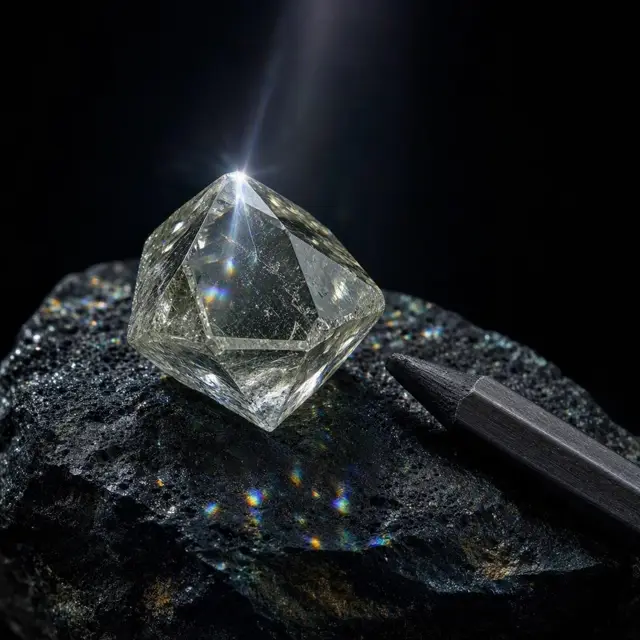
Here is a strange truth about the world's most famous gem: it is made of the same element as the grey stuff in your pencil. Diamond and graphite are both pure carbon. The only difference is how the atoms are arranged.
In graphite, the carbon atoms sit in flat sheets that slide over each other easily. In diamond, every atom is locked tightly to its neighbours in a rigid 3D pattern called a crystal structure. That tight grip is what makes diamond so hard.
Even stranger, at normal room temperature and pressure, graphite is actually the more stable form. Diamond is metastable, which means it should slowly turn into graphite. But the change is so slow that it would take millions to billions of years. So your ring is safe.
The Man Who Set a Diamond on Fire
For a long time, nobody knew what diamonds were made of. That changed in 1772, when the French scientist Antoine Lavoisier did something bold. He used a lens to focus sunlight onto a diamond sitting in oxygen, and it burned.
The only thing left behind was carbon dioxide. That proved diamond is made of carbon. In 1797, the English chemist Smithson Tennant went one step further. He burned both diamond and graphite and showed they gave off the same amount of gas, so they had to be the same substance.
The name itself tells you how people saw the stone long before that. "Diamond" comes from the Ancient Greek word adámas, which means unbreakable or untamed.
Born Deep, Delivered by Volcanoes
Most natural diamonds are very old. Their ages range from about 1 billion to 3.5 billion years, which means many formed when Earth was still young.
They grew far below our feet, usually 150 to 250 kilometres down in the Earth's mantle, where heat and pressure are extreme. A few came from as deep as 800 kilometres.
Getting them to the surface took a violent ride. Much later, volcanic eruptions carried them up inside a rock called kimberlite. The magma rose at 4 to 20 metres per second, and at the surface the eruption burst out at more than 200 metres per second. Diamonds were first known and mined in India, along rivers where they had washed out of the ground, at least 3,000 years ago and probably as long as 6,000 years ago.
Hard, but Not Unbreakable
Diamond is the hardest material on the Mohs scale, the classic ranking of how easily one mineral can scratch another. It also moves heat better than any other natural material. That is why diamonds are used in tools that cut and polish.
But hard does not mean indestructible. Diamonds are also brittle, so a single well-aimed blow can split one. They can be scratched by other diamonds, and over time they can even be worn down by softer things like old vinyl records.
Cutting a rough stone into a gem is slow, careful work. Studying a rare stone before cutting can take years, and the cutting itself can remove about half of its weight.
Diamond Rain on Other Worlds
Diamonds are rare on Earth, but they are very common in space. In meteorites, about three percent of the carbon is in the form of tiny nanodiamond grains, only a few billionths of a metre across. Some of these grains were made in stars outside our Solar System.
Scientists predict something even wilder on Uranus and Neptune. Experiments suggest that huge amounts of diamond could form from methane there and fall as "diamond rain."
Back on Earth, people now make their own. Synthetic diamond can be grown in a lab, and the best ones are so close to natural stones that only an expert with special equipment can tell them apart. Most synthetic diamonds, roughly 1,000 tonnes a year as of 2010, go to industry rather than jewellery.