The Athenians Thought Voting Was Undemocratic
An election is a group decision-making process in which some or all of a population votes to choose people to hold public office. Since the 17th century it has been the usual mechanism by which representative democracy operates.
Which makes the original democracy's opinion of it genuinely startling. In ancient Athens, the democratic archetype, elections were considered an oligarchic institution, and most political offices were filled instead by sortition, meaning office holders were chosen by lot.
The reasoning is not hard to reconstruct. An election rewards whoever is best known, best connected or best funded. A lottery does not. If you want government by ordinary citizens rather than by a permanent political class, drawing names is the more reliable method.
So the system we treat as the definition of democracy was, to the people who invented democracy, the compromise you made when you could not draw lots.
Older and Stranger Than You Would Guess
Elections were in use in ancient Greece and ancient Rome, and continued through the medieval period to select rulers including the Holy Roman Emperor and the pope.
The first recorded popular elections of public officials, where all citizens could both vote and hold office, were the elections of the Ephors of Sparta in 754 BC, under the Spartan Constitution, using a multiple-winner system and voting by voice. Athenian elections open to all citizens did not arrive for another 247 years.
Early Athens was more restrictive than its reputation suggests. Under the Solonian Constitution of around 574 BC, all citizens could vote in the popular assemblies and serve as jurors, but only the three highest classes could vote in elections, and the lowest of the four classes could not hold public office at all.
Elections appeared elsewhere too. The Pala king Gopala in early medieval Bengal was elected by a group of feudal chieftains, and such elections were quite common in the region.
Palm Leaves in a Mud Pot
One of the most charming voting systems on record comes from the Chola Empire, around 920 CE, in Uthiramerur in present-day Tamil Nadu.
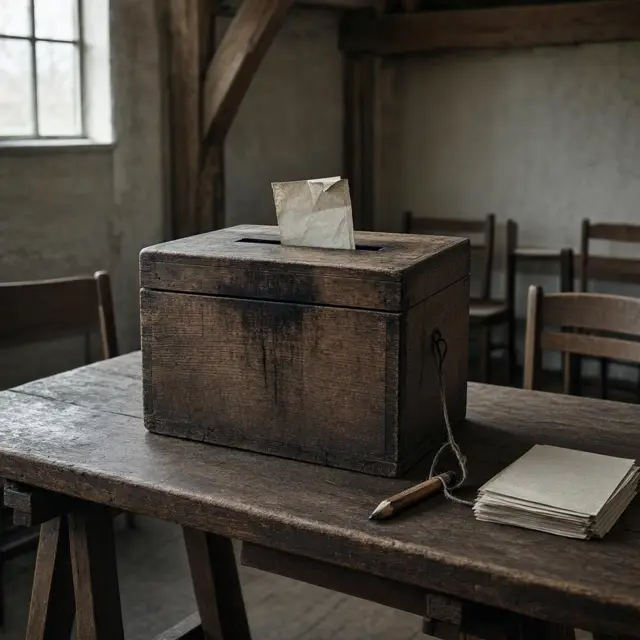
It was called the Kudavolai system, and it worked like this. Candidates' names were written on palm leaves. The leaves were placed inside a mud pot. To choose the village committee, a young boy was asked to draw out as many leaves as there were positions available.
It is worth pausing on what that design achieves. Using a child to draw the leaves removes the possibility of the drawer having an interest in the outcome, and the mud pot removes any ability to see what you are picking. It is a physical guarantee of fairness built out of the cheapest possible materials.
The study of election results and the statistics around them, especially with an eye to predicting future results, has its own name: psephology.
Who Was Allowed to Vote
Questions of suffrage, particularly for minority groups, have dominated the history of elections more than any question of mechanism.
Males, as the dominant cultural group in North America and Europe, often dominated the electorate and continue to do so in many countries. Early elections in places like the United Kingdom and the United States were dominated by landed or ruling class men.
Progress was late and uneven. By 1920 all Western European and North American democracies had universal adult male suffrage, with the exception of Switzerland, and many countries were only then beginning to consider votes for women.
Even legally guaranteed suffrage has not always been real suffrage. Political barriers were sometimes erected to prevent fair access to the vote despite universal suffrage being formally mandated for adult males. Electoral reform is the name for the ongoing work of introducing fair systems where they do not exist, or improving the fairness of ones that do.