Shocking Fish and Amber Tricks
Long before anyone knew what electricity was, people felt it. Ancient Egyptian texts from 2750 BCE described electric fish as the "protectors" of all other fish. Later, Greek, Roman and Arab doctors wrote about their numbing shocks. Some even told patients with headaches or gout to touch the fish, hoping the jolt would cure them.
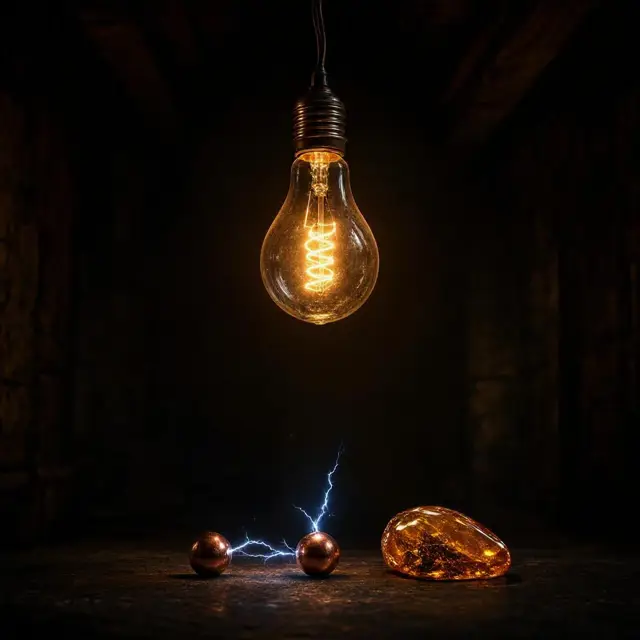
Around the Mediterranean, people also noticed something odd. If you rubbed a rod of amber with cat fur, it could pull light things like feathers toward it. This is static electricity.
Around 600 BCE, the Greek thinker Thales of Miletus studied the effect. He thought rubbing made amber magnetic. He was wrong, but later science would prove that electricity and magnetism really are linked.
A Word Born From Amber
For thousands of years, electricity stayed little more than a curiosity. Then, in 1600, the English scientist William Gilbert wrote a careful study of electricity and magnetism.
He needed a name for the way rubbed amber attracts small things. He chose electricus, meaning "of amber", from elektron, the Greek word for amber. That gave English the words "electric" and "electricity", which first appeared in print in 1646.
In the 1700s, Benjamin Franklin sold his own belongings to pay for his electrical research. In June 1752, he is said to have flown a kite with a metal key tied to its wet string during a storm. Sparks jumped from the key to his hand, showing that lightning is electrical.
Frogs' Legs and the First Battery
In the late 1700s, the Italian scientist Luigi Galvani made the legs of dead frogs twitch using electricity. His work showed that neurons use electricity to send signals to the muscles. The eerie experiments caught the public imagination, and Mary Shelley knew of them when she wrote Frankenstein.
Then, in 1800, Alessandro Volta built the voltaic pile, a stack of zinc and copper layers. It was the ancestor of the modern battery, and it gave scientists a steady supply of electricity for the first time.
Discoveries came quickly after that. In 1820, Hans Christian Ørsted noticed by accident that a wire carrying current moved a compass needle. In 1821, Michael Faraday invented the electric motor.
Slow Electrons, Fast Signals
Here is a surprise about the wires in your walls. The tiny charged particles moving through them, called electrons, can drift very slowly, sometimes just fractions of a millimetre per second.
So how does a light switch on instantly? The push that drives those electrons travels through the wire at close to the speed of light. That is why a signal can cross a long wire almost at once.
There are two main kinds of flow. Direct current, like the power from a battery, flows one way. Alternating current, the kind in most homes, keeps switching direction back and forth. Most of our electricity is made by generators, which still rely on a principle Faraday discovered in 1831.
Nature Got There First
Electricity is not a human invention. Lightning is its most dramatic form, but it is also at work in everyday things. Touch, friction and the way chemicals bond all come down to electric forces between atoms.
Some animals are experts. Sharks can sense tiny electric fields to find prey. The electric eel can stun its prey with high voltages made by special muscle cells. And every animal, including you, sends messages along its nerves as tiny electrical pulses.
Even some crystals, such as quartz, and even sugar, make electricity when squeezed. This effect is called piezoelectricity, and it was discovered in 1880 by the brothers Pierre and Jacques Curie.