Finished Before You Were Born
The pattern on your fingertips was set around the 15th week of pregnancy, as ridges of skin — friction ridges — formed along ledges where the skin's layers meet. From that moment on, the design never changes. It survives a lifetime of wear and remains until decomposition after death: detailed, unique, difficult to alter, and durable.
Everyone's ridges settle into one of a few grand designs. Loops are the most common, covering 60 to 65% of fingerprints; whorls account for 30 to 35%; and simple arches are the rarest at about 5%. The patterns run in families — identical twins have similar (though never identical) prints — yet only about 5% of the variability comes from environmental effects. Your exact ridge map belongs to you alone.
The Thumbprint That Solved a Murder
Fingerprinting entered law slowly, then all at once. In 1858, Sir William Herschel began using handprints in India to authenticate contracts. In 1880, Henry Faulds published the idea that prints could identify criminals. Then came 1892, and a case that changed forensic history: in Argentina, police officer Juan Vucetich — who had just created the first fingerprint filing system — saw a bloody thumb mark at a murder scene matched to Francisca Rojas, producing the first murder conviction ever based on fingerprint evidence.
The technique spread fast. Scotland Yard adopted fingerprint methods in 1901, the first murder conviction on print evidence in Europe followed in 1902, and by 1910 Edmond Locard had founded France's first forensic laboratory. A century later, the FBI's fingerprint database alone holds records for over 51 million criminal subjects.
The Ghost Prints You Leave Everywhere
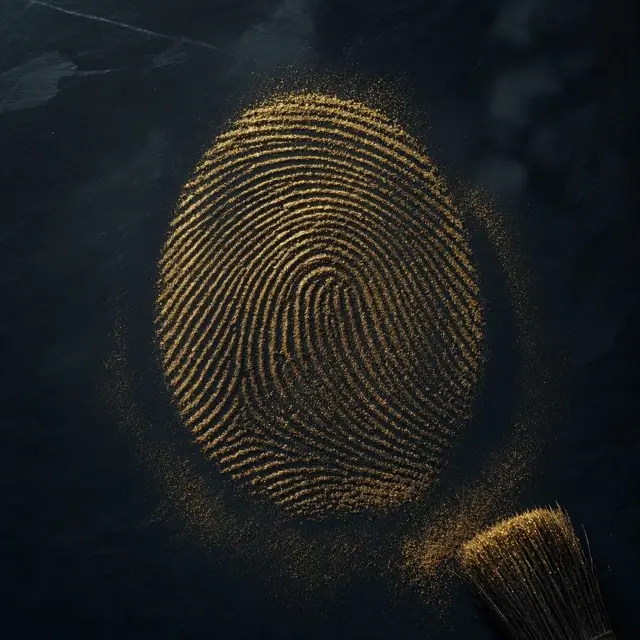
A fingerprint is mostly water — 95 to 99% — plus traces of amino acids, proteins, fats, and salts. Every smooth surface you touch keeps a copy. Visible marks in ink or chocolate are called patent prints; impressions pressed into soap or cement are plastic prints. The interesting ones are latent prints: invisible residues that must be developed like photographs.
Forensic laboratories command roughly 20 truly effective techniques for raising them — dusting with powders, fuming with iodine or superglue vapor, and chemicals like ninhydrin that react with the amino acids in sweat. Matching relies on minutiae: the tiny ridge events — endings, forks, islands, bridges — whose constellation is compared between prints. By 2010, laboratory techniques accounted for identifying half or more of the fingerprints recovered from crime scenes.
Less Infallible Than Television Says
Here's what crime dramas skip: fingerprint matching has no uniform global standard. England has required 16 matching points, France 12 — and the United States has no fixed national standard at all. Academics have argued that the error rate of matching has never been adequately studied and that fingerprint evidence lacks a secure statistical foundation. Experiments show experts can be swayed by context — told the "right" backstory, they may see a match differently.
The biological oddities are just as striking. A rare genetic condition, adermatoglyphia, produces people with no fingerprints at all — researchers nicknamed it "immigration delay disease", and only five families were documented as of 2011. Meanwhile your phone's fingerprint sensor, standard since the 2000s, can be fooled by fake fingerprints cast in gels. And in a final twist of evolution, koalas have fingerprints remarkably like ours.