What You Are Actually Looking At
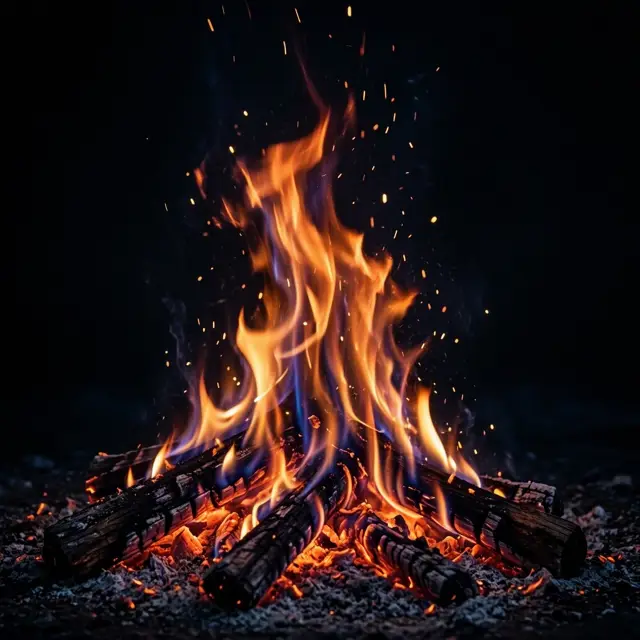
Fire is the rapid oxidation of a fuel in the heat-releasing chemical process of combustion, giving off heat, light and various reaction products. It is not a substance. It is an event in progress.
The flame, the part you can see, appears when the fuel reaches its ignition point temperature. Flames from hydrocarbon fuels are made mostly of carbon dioxide, water vapour, oxygen and nitrogen. So a candle flame is largely the same stuff as ordinary air and exhaled breath, just reacting.
Get it hot enough and something stranger happens: the gases can become ionised and turn into plasma, the fourth state of matter.
The colour and intensity depend on what is burning and on the gases around it. That is why a gas hob burns blue and a campfire burns orange. You are not seeing different kinds of fire. You are seeing different fuels and different temperatures.
For Most of Earth's History, Fire Was Impossible
There is no fire without oxygen, and for billions of years the atmosphere did not have enough.
The fossil record of fire only begins with the spread of plants onto land in the Middle Ordovician, 470 million years ago. Those plants pumped out oxygen as a waste product, and once the concentration climbed above 13% a wildfire became possible at all. The first recorded wildfire shows up in the Late Silurian, 420 million years ago, as fossils of charred plants. Apart from one disputed gap, charcoal has been in the record ever since.
The correlation is tight enough to be convincing: the level of atmospheric oxygen tracks the amount of charcoal in the fossil record, which points squarely at oxygen as the thing that decides whether a planet can burn.
Fire got another boost far later. When grasses came to dominate many ecosystems around 6 to 7 million years ago, they provided excellent tinder, and fire spread faster than ever.
The Night We Took Control of It
Being able to control fire changed early human life more than almost anything else. Cooking increased the variety and availability of nutrients while killing harmful microorganisms in food. Heat let people live in colder places. And it kept nocturnal predators away.
The dates are worth sitting with. Evidence of occasional cooked food goes back a million years, suggesting some controlled use. The oldest clear evidence of deliberately making fire is around 400,000 years old, from a site in England where pyrite appears to have been struck against flint.
Evidence becomes widespread between 50,000 and 100,000 years ago, which suggests regular everyday use from that point. There is a striking footnote to this: resistance to air pollution began to evolve in human populations at about the same time. We have been breathing our own smoke for long enough to have adapted to it.
Cool Fires and Hot Fires
By the time farming arrived, people all over the world were using fire as a land management tool, and they distinguished carefully between two kinds.
Controlled burns, sometimes called cool fires, are set in spring and autumn. They clear undergrowth and burn off the biomass that would otherwise pile up and feed a disaster. They create a greater variety of environments, which encourages both game and plant diversity, and they make dense forest passable. Hot fires do the opposite: they damage soil, destroy plants and animals and threaten communities.
Suppressing traditional burning to protect timber crops has made that problem worse in many modern forests.
The scale today is hard to picture. Globally, as much as 5 million square kilometres burns in a given year, an area more than half the size of the United States. Fire also strips nitrogen from the soil in a way other nutrients are not stripped, since potassium and phosphorus stay behind in the ash.