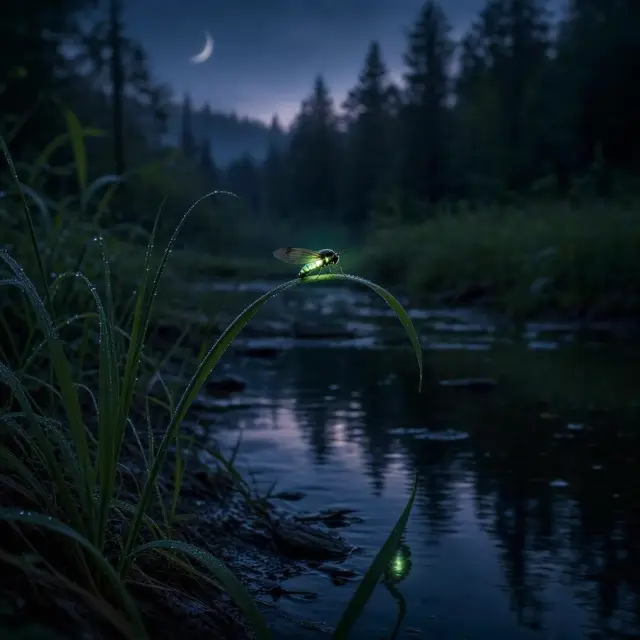
A Glow That Began as a Warning
Fireflies are not flies at all. They are soft-bodied beetles, and scientists have described more than 2,400 species. Depending on where you live, you might call them lightning bugs or glowworms.
Their famous glow probably did not start as romance. Scientists think it began as a warning. Every firefly glows as one of the larvae, and that light tells hungry animals to stay away. Most fireflies taste bad to animals with backbones. Their bodies hold chemicals called lucibufagins, which are similar to the heart-affecting toxins found in some poisonous toads.
Later, fireflies borrowed this warning light for a new job: finding a mate. Today, adults mainly glow at twilight to attract partners. Still, not every adult lights up. In some species only the young glow, and the grown-ups stay dark.
Light Without Heat
The glow comes from bioluminescence, a chemical reaction inside special light organs, usually on the lower belly. A firefly makes an enzyme called luciferase, which acts on another compound it makes, called luciferin. When magnesium, oxygen and a cell fuel called ATP are all present, the reaction gives off light. The oxygen arrives through a breathing tube in the abdomen.
This is "cold light". It carries no infrared or ultraviolet, just yellow, green or pale red. The "blue ghost" firefly of the eastern United States looks bluish-white from far away in dim light. Up close, its glow is actually bright green.
People have put this chemistry to work. Scientists have inserted the genes for these substances into many different organisms. Firefly luciferase is used in forensics, and in medicine it helps detect ATP or magnesium.
Flash Codes and Femme Fatales
Each firefly species has its own way of flirting. In groups like Photinus, flying males flash special patterns while they search for females. The codes differ in length, timing, color and number of flashes, and even in how high the male flies and whether he climbs or dives. A Photinus female usually does not fly. She answers from below, flashing back to males of her own kind.
Then there are the tricksters. Females of the genus Photuris copy the flash pattern of the smaller Photinus. A hopeful male flies down, expecting a mate. Instead, she eats him.
This "femme fatale" trick is not just about dinner. By eating these males, the Photuris female collects their toxic defensive chemicals. Some other species skip light entirely and court with pheromones, which were the original way fireflies found partners.
Thousands Blinking at Once
In some places, fireflies do something even stranger. They flash together. Tropical fireflies, especially in Southeast Asia, routinely match their flashes across large groups. At night along river banks in the Malaysian jungles, they keep their light in precise time. Scientists explain this as phase synchronization, a kind of spontaneous order. Why it happens is still an open question, with ideas involving diet, social contact and altitude.
In the town of Donsol in the Philippines, thousands of fireflies can be seen all year round. In the United States, one of the most famous shows happens every year near Elkmont, Tennessee, in the Great Smoky Mountains, during the first weeks of June. Congaree National Park in South Carolina hosts the same sight.
In Japan, fireflies are called hotaru. Their arrival signals the changing seasons, and some parks exist just for watching them in midsummer.
Mouthless Adults and Ancient Amber
Firefly lives can be surprisingly odd. Most young fireflies are fierce little hunters of snails, slugs and other larvae. Some have grooved jaws that deliver digestive juices straight into their prey. This young stage can last a few weeks or, in some species, two years or more. Most fireflies spend the winter in it, hidden underground or under tree bark.
Adults often live only a few weeks in summer. Some, like the European glow-worm, have no mouth at all. They emerge only to mate and lay eggs.
Fireflies are old, too. The oldest known fossils were trapped in Burmese amber about 99 million years ago, and their light organs are clearly visible. Genetic studies suggest the first fireflies glowed green. Sadly, numbers seem to be falling worldwide. Artificial light at night is an especially worrying threat, because it can disrupt their courtship signals.