A Country in Crisis
The French Revolution was a period of dramatic political change in France, from 1789 to 1799. Many of its ideas are now seen as basic principles of modern democracy.
It grew out of a deep crisis. France's population had grown from 21 to 28 million, but ordinary workers and farmers were getting poorer. Bad harvests in 1787 and 1788 sent food prices soaring. Meanwhile, the state had borrowed so heavily that by 1788, half of its income went on paying its debts.
Taxes were deeply unfair. The nobles and the Church enjoyed many exemptions, so most of the burden fell on everyone else. When the government tried to reform taxes, powerful groups blocked it, insisting that only the Estates-General could approve new taxes. That assembly had not met since 1614.
It finally met at Versailles in May 1789. But the rules let the clergy and the nobles, who made up less than 5 percent of the population, outvote everyone else.
Seven Prisoners in the Bastille
The representatives of ordinary people, the Third Estate, refused to accept this. On 17 June 1789, they declared themselves the National Assembly. When they found their meeting hall locked, they gathered at an indoor tennis court and took the Tennis Court Oath, promising not to break up until France had a constitution.
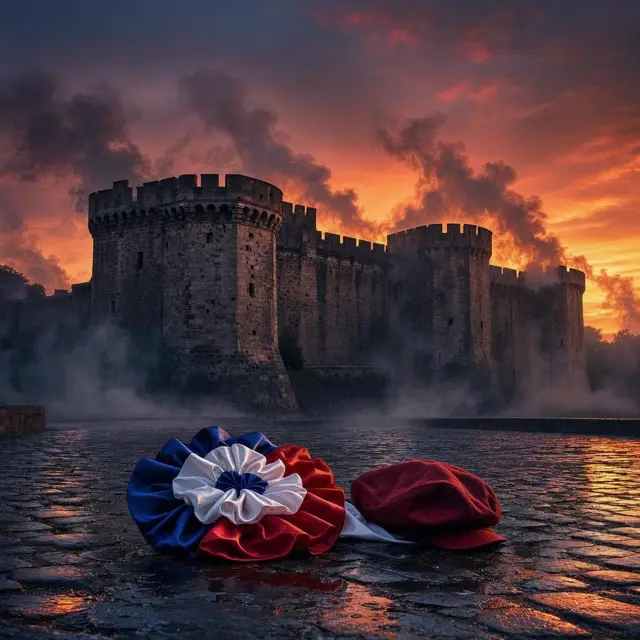
Then, on 14 July, crowds attacked the Bastille, a royal fortress in Paris holding large stores of weapons. After several hours of fighting, its governor surrendered.
The Bastille was rumoured to be packed with prisoners. In fact, it held only seven. Even so, it was a powerful symbol of royal power, and it was torn down in the following weeks. The day is now France's national holiday.
Change came quickly. In August, the Assembly abolished feudalism, ending the payments peasants owed to landowners, and issued the Declaration of the Rights of Man and of the Citizen. Equality before the law and freedom of worship followed. In less than four months, the main pillars of the old system had been swept away.
From King to Republic
King Louis XVI was caught between the revolutionaries and those who wanted to turn back the clock. In June 1791, he tried to flee Paris with his family, and his attempted escape to Varennes badly damaged trust in the monarchy.
In April 1792, France went to war with Austria and Prussia and suffered heavy defeats. Anger boiled over in Paris, and in August, crowds attacked the Tuileries Palace. The king was suspended, and in September 1792 France became a republic. Louis XVI was executed in January 1793.
The Revolution also gave France symbols it still uses. Revolutionaries pinned blue, white and red rosettes to their clothes, colours that later formed the tricolore flag. The song La Marseillaise was written in 1792 and got its name after volunteers from Marseille sang it while marching into Paris. It is still France's national anthem.
The liberty cap, a soft cone-shaped hat, became another symbol. It came from ancient Rome, where freed slaves were given one to mark their freedom.
The Terror and What Came After
The Revolution then turned violent. In 1793, the Committee of Public Safety, dominated by radicals led by Maximilien Robespierre, took control, and the Reign of Terror began.
From September 1793 to July 1794, around 300,000 people were arrested as suspected enemies of the Revolution, and some 16,600 were officially executed. The guillotine, a machine for carrying out executions, became the main symbol of the Terror. In the end, Robespierre's own allies turned on him. He was arrested and executed in July 1794, and the Terror ended.
The years that followed were unstable. In 1799, a young general named Napoleon Bonaparte seized power, bringing the Revolution to a close.
Its effects lasted far longer. The power of the nobles was broken for good, and their special privileges were never restored. Large estates were split into small farms. France became, permanently, a society where everyone was equal under the law, and one historian observed that revolution itself became a French tradition.