Not a Plant, Not an Animal
Fungi are their own kingdom, alongside plants and animals rather than inside either. The group covers yeasts, molds and mushrooms, and it split off from our shared ancestry around a billion years ago.
For a long time they were filed under botany, and the misconception survives because the resemblance is easy to see: fungi usually sit still, often grow in soil, and some fruit bodies look vaguely like mosses. Genetically, though, they are closer to animals than to plants.
The giveaway is how they eat. Fungi cannot photosynthesise. They absorb dissolved organic molecules from their surroundings, typically by pushing digestive enzymes out into the material and taking back what dissolves. That makes them the principal decomposers in almost every ecosystem.
Their walls settle the question. A fungal cell wall combines chitin, which also forms insect shells, with glucans, which are found in plants. No other organism builds a wall from both, and unlike plants the wall contains no cellulose.
Threads, Not Bodies
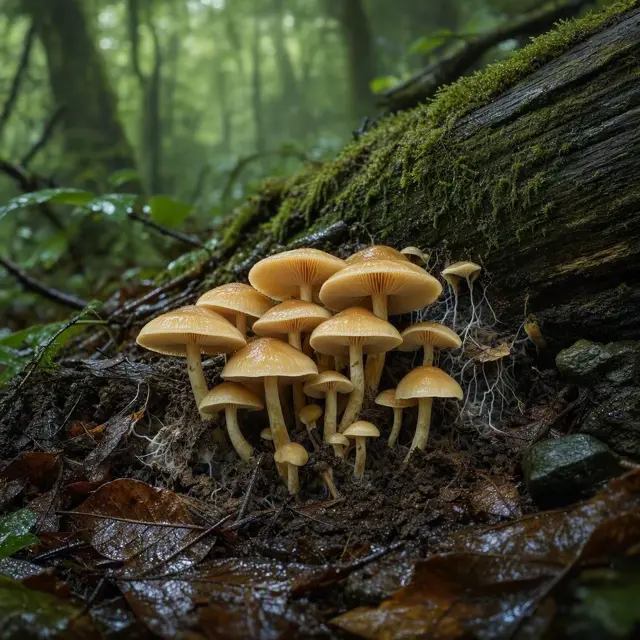
Most fungi grow as tubes: long thread-like filaments called hyphae that extend by adding material at their tips, and often contain more than one nucleus per cell. A mass of them together forms the mycelium, which is the actual organism. The mushroom you see is only the fruit body.
Growth is also how they move, since apart from spores a fungus has no way of travelling. Some species take a different form entirely and live as single-celled yeasts, reproducing by budding, and some can switch between the two depending on conditions.
Mycelium is usually invisible until it is not. On damp walls or spoiled food it becomes what we call mold.
The scale it can reach is startling. A single clonal colony of Armillaria solidipes covers more than 900 hectares, about 3.5 square miles, and is estimated to be nearly 9,000 years old. Because fungi have no plumbing equivalent to the xylem of plants, some species build root-like strands to move water and nutrients across distances.
Firing Spores at 10,000 g
Most fungal spores travel by wind, which is why many species make dry, water-repelling spores that scatter easily when a raindrop lands.
Others do not wait for weather. Some ascomycetes build up pressure in their spore-bearing cells until the spores are discharged explosively into the air. The most remarkable mechanism involves a tiny water droplet forming on the spore, which on contact launches it with an initial acceleration of more than 10,000 g. The spore only travels a fraction of a millimetre, but that is exactly enough to clear the gills of a mushroom and drop into open air.
Other designs are cruder and just as effective. Puffballs rely on something bumping into them. Bird's nest fungi use the impact of falling raindrops to knock spores out of their cup-shaped bodies. Stinkhorns take the opposite approach, combining bright colours with a putrid smell to attract insects that carry the spores away.
Partners, Pests and Provisions
Over 90 percent of plant species form mycorrhiza, a partnership where fungal threads meet roots and trade with them. The fungus supplies nitrate and phosphate the plant struggles to extract from poor soil, and takes carbohydrates in return. The arrangement is at least 400 million years old, and some plants cannot survive without it.
Lichens work on the same logic. A fungus pairs with an alga or cyanobacteria that photosynthesises for it, and the two together behave almost as one organism. About 27 percent of known fungal species live this way, more than 19,400 of them, growing on bare rock, bark and shells in polar and desert conditions.
People have used fungi since prehistory. Otzi the Iceman, frozen 5,300 years ago, carried two polypore species, possibly for tinder or medicine. Fungi leaven bread and ferment wine, beer and soy sauce, and since the 1940s have supplied antibiotics. They also rot crops and buildings, and about 148,000 species have been described against an estimate of 2.2 to 3.8 million.