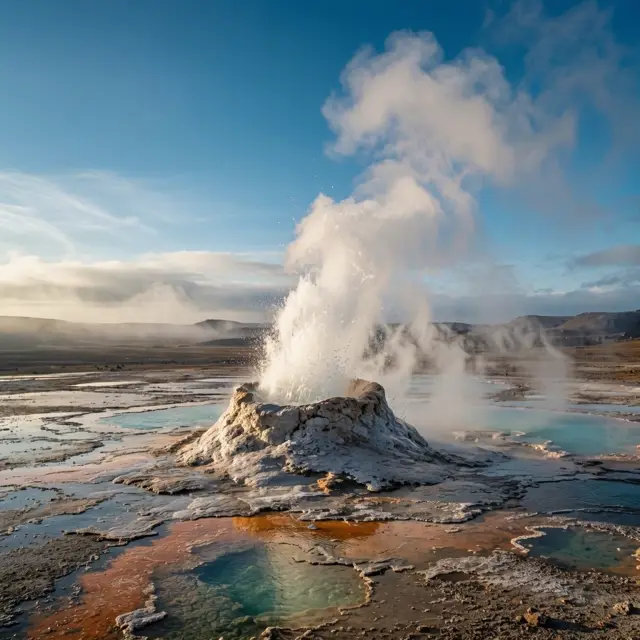
Earth's Own Pressure Cooker
The word geyser comes from Geysir, one single hot spring in Iceland. Its name means "Gusher" in Icelandic. English borrowed it in the late 18th century, and now every spouting spring on the planet carries its name.
A geyser starts with plain surface water. It seeps down through the ground, on average to around 2,000 metres, until it meets rock heated by nearby magma. The water collects in an underground reservoir linked to the surface by a narrow channel. That narrow channel is the secret. The cooler water on top presses down like the lid of a pressure cooker. The water below becomes superheated, staying liquid far above its normal boiling point.
Then boiling starts at the bottom. Steam bubbles push up and some water splashes out of the vent. That lowers the pressure on the water below, and it suddenly flashes into steam. A froth of steam and hot water blasts into the air. When the water cools, the eruption stops and the whole cycle starts again.
A Rare and Fragile Wonder
Plenty of volcanic places have hot springs, mud pots and steam vents. Very few have geysers. A geyser needs three things at once: heat, water, and underground plumbing with just the right shape. If the rock is too loose, the eruptions wear away the channels and quickly destroy a young geyser.
Geysers also build their own walls. The hot water dissolves silica from rocks like rhyolite. Near the surface it cools, and the silica drops out as a kind of opal that slowly turns into quartz. This crust is called geyserite, and it coats many geysers.
Even so, geysers are delicate. Many have been ruined simply by people throwing debris into them. Others stopped when geothermal power plants drained their water. Nevada once had two large geyser fields, Beowawe and Steamboat Springs, and both were lost to nearby power plants. Even the famous Geysir has gone quiet for long stretches. During those times, people sometimes forced it to erupt on special occasions by adding soap to the water.
Life in Boiling Water
Some geysers have their own colours, and the reason is alive. Tiny heat-loving microbes grow in them, despite the harsh conditions. In the 1960s, when scientists first studied the biology of geysers, most believed nothing could live above about 73 °C. That was the known upper limit for cyanobacteria.
They were wrong. Some bacteria actually prefer temperatures above the boiling point of water, and dozens of them are known. Ordinary thermophiles like 50 to 70 °C, while hyperthermophiles grow better at 80 to 110 °C. Microbial mats can even become part of the rock, making up as much as half the volume of the mineral crust around a geyser.
These microbes are useful too. Their enzymes keep working at high heat, so they have become important tools in medicine and biotechnology. They help in making antibiotics, plastics, detergents and ethanol. The first one discovered, and the most important for biotechnology, is a bacterium called Thermus aquaticus.
The World's Great Geyser Fields
Yellowstone National Park is the biggest geyser spot on Earth. It holds roughly 300 to 500 geysers, about half the world's total, spread over nine geyser basins. It has Steamboat Geyser, the world's tallest active geyser, and Old Faithful, a classic cone geyser that shoots from a mound of mineral crust. Grand Geyser, also in Yellowstone, is the tallest predictable geyser on Earth, erupting for up to 10 minutes every 8-12 hours.
Russia's Valley of Geysers on the Kamchatka Peninsula comes second, with about 200 geysers. Most of them erupt at an angle instead of straight up. In Chile, El Tatio sits around 4,200 metres high in the Andes. Its name comes from the Quechua word for oven. Its roughly 80 geysers are short: the average eruption is only about 750 millimetres tall.
The largest geyser ever known was Waimangu in New Zealand. It started erupting in 1900 and kept going for four years, usually reaching 160 metres, with some bursts reaching 500 metres. In Iceland, Strokkur still erupts every 5-8 minutes to about 30 metres.
Geysers on Other Worlds
Earth is not the only place with geyser-like jets. On several moons of the outer Solar System, scientists have seen eruptions often called cryogeysers. Because the pressure there is so low, the jets are vapour without liquid water, made visible by the dust and ice they carry.
Saturn's moon Enceladus has the most impressive ones. The Cassini orbiter saw plumes of water vapour and ice rising from cracks called "tiger stripes" near its south pole. These plumes supply the material in Saturn's E ring. Cassini flew through them several times, which let scientists analyse water from inside another Solar System body for the first time.
Neptune's moon Triton has nitrogen eruptions instead. When Voyager 2 flew past in 1989, it found plumes up to 8 km high, with winds stretching them 150 km downwind. On Mars, jets of carbon dioxide are believed to burst through dry ice in the southern spring, leaving dark spots and spider-like patterns visible from orbit. In 2013, the Hubble Space Telescope also spotted possible water vapour plumes about 200 km high above Jupiter's moon Europa.