A Rock Made of Ice
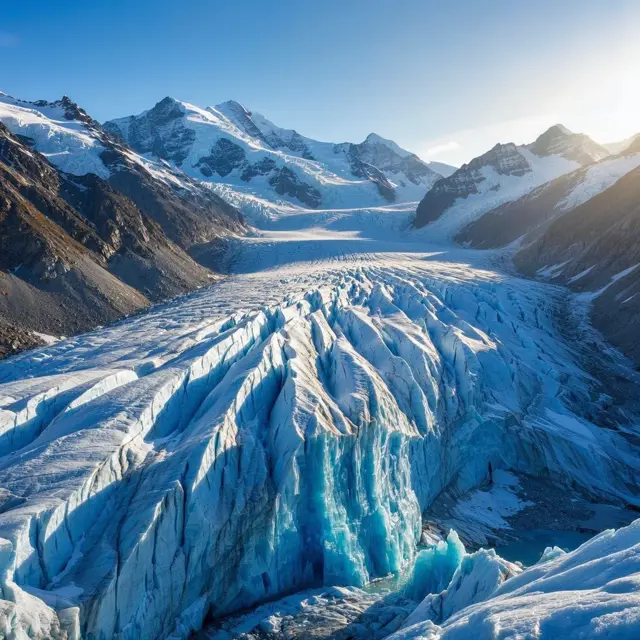
A glacier counts as a kind of rock. It is a lasting body of natural ice that is always moving under its own weight. It forms wherever more snow piles up than melts away, year after year, often for centuries. And unlike sea ice or lake ice, a glacier always starts on land.
The numbers are huge. Glaciers cover about 10% of Earth's land, and together with ice sheets they hold about 69% of the world's fresh water. Almost all of that ice, 99%, sits in the giant polar ice sheets. In Antarctica, ice covers about 98% of the continent and averages 2,100 meters thick.
Outside the poles, the surprise winner is Pakistan. With more than 7,000 known glaciers, it has more glacial ice than any other country outside the polar regions. Glaciers show up on every continent except mainland Australia, and even Africa has them, on Mount Kilimanjaro and Mount Kenya.
How Snow Turns Blue
A glacier usually begins in a cirque, an armchair-shaped hollow between mountains that traps falling snow. The snow piles up, refreezes and turns grainy. As more layers press down, the snowflakes get crushed and the air gets pushed out. The grainy snow becomes a denser layer called firn, and after years of squeezing, it turns into true glacial ice.
Once the ice is thick enough, gravity takes over and it starts to spill out of its hollow. On steep slopes, as little as 15 meters of snow and ice is enough to get it moving.
That squeezing also explains the famous color. Air bubbles make ice look white, and pressure forces them out. What is left is dense ice that absorbs some red light, so it looks blue, for the same reason water looks blue. Many people blame the blue on light bouncing off bubbles, but that is a misconception.
Slow Rivers, Sudden Sprints
Ice needs to be at least 30 meters thick before it starts to flow. Past about 50 meters, the layers inside begin sliding over one another, and the glacier creeps across the land under its own weight. The surface moves fastest, while the bottom and sides drag against rock.
A typical glacier moves about 1 meter a day. Some parts barely move at all: in parts of Alaska, trees grow on the dirt resting on top of the ice. Others are speedsters. Greenland's Jacobshavn Isbræ can move 20 to 30 meters a day.
A few glaciers have surges, sudden bursts of speed before they calm down again. When meltwater pools underneath, rates of up to 90 meters a day have been recorded. Where a glacier moves faster than one kilometer a year, it can even set off glacial earthquakes as strong as magnitude 6.1. In Greenland, these quakes peak every year in July, August and September.
Cracks, Scratches and Giant Sandpaper
The top 50 meters of a glacier stay stiff, so when the ice below bends, the surface cracks. These cracks, called crevasses, are rarely deeper than 46 meters, but some reach at least 300 meters. Where crevasses cross, they leave lone towers of ice called seracs.
Glaciers also reshape the land beneath them. In plucking, water seeps into cracks in the bedrock, freezes, expands and pries blocks of rock loose. The ice then drags its load of stones over the bedrock like sandpaper, grinding rock into a fine powder called rock flour and carving long scratches that show which way the ice moved. Thick ice digs deep, too: fjords can reach a kilometer in depth.
When the ice melts, the clues stay behind. Boulders carried far from home, known as glacial erratics, can look nothing like the ground they land on. Ice also molds canoe-shaped hills called drumlins. One field east of Rochester, New York, holds about 10,000 of them.
Frozen Diaries and Ice on Other Worlds
Glaciers can be hundreds of thousands of years old, and they keep notes. Scientists study ice cores, where deeper layers hold older air in tiny bubbles. By testing those bubbles, researchers have shown that for at least the last million years, global temperatures have been linked to carbon dioxide levels.
Ice is also heavy enough to push the ground down. A big ice sheet presses Earth's crust into the mantle by about a third of the ice's thickness. When the ice melts, the land slowly rises back up. This post-glacial rebound is still going on today in Scandinavia and the Great Lakes region of North America.
Glaciers are not just an Earth thing. The polar ice caps of Mars show signs of glacial deposits, and radar found ice hiding under thin layers of rock there. In 2015, the New Horizons spacecraft spotted glaciers of nitrogen ice on Pluto, flowing into and out of a huge basin called Sputnik Planitia.