The Myth of the Slowly Flowing Window
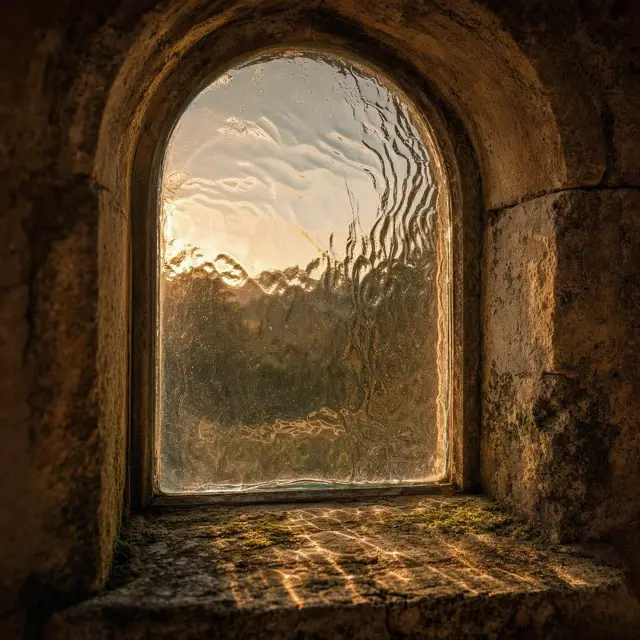
Walk into an old church and you might notice something odd. Some old window panes are thicker at the bottom than at the top. For years, people pointed to this as proof that glass is secretly a liquid, slowly sagging downward over the centuries.
It is a great story, but it is wrong. Once glass becomes solid, it stops flowing. The sags and ripples in old windows were there on the day the glass was made. Older methods simply produced sheets with uneven surfaces and uneven thickness. The near-perfect flat glass we use today only became common in the 1960s.
A 2017 study put numbers on it. Researchers looked at medieval glass from Westminster Abbey, dating from 1268. They worked out its viscosity and found that the fastest this glass could flow is 1 nanometre per billion years. No human could ever see that happen.
A Solid Without a Pattern
So what is glass, really? Scientists call it an amorphous solid. In a crystal, atoms line up in a neat pattern that repeats over long distances. In glass, that long-range order is missing. Up close, small groups of atoms are still arranged in an orderly way, but the big pattern never forms.
Glass usually forms when melted material cools very fast. If the cooling is quick enough, the atoms have no time to settle into crystals. Their messy arrangement gets frozen in place, like a liquid caught in mid-motion.
That is why some people call glass a liquid. But glass behaves like a solid in every mechanical way. Nature makes it too. Obsidian forms when volcanic lava cools quickly. When lightning strikes sand, it can make hollow, branching, root-like tubes of glass called fulgurites.
Older Than Iron
People used glass long before they made it. Stone Age groups prized obsidian because it breaks along very sharp edges, which made it ideal for arrowheads and knives.
Making glass on purpose is also very old. Archaeological evidence suggests it goes back to at least 3600 BC, in Mesopotamia, Egypt, or Syria. That is long before humans learned to smelt iron. The earliest known glass objects were beads. They may have been made by accident during metalworking or while making faience.
Early glass was rarely clear. It was often full of impurities and flaws. Red-orange glass beads from the Indus Valley Civilization date to before 1700 BC. Steady glass production appeared around 1600 BC in Mesopotamia and 1500 BC in Egypt. Workers often shaped it with tricks borrowed from stoneworking, grinding and carving the glass while it was cold.
From Roman Trier to the Island of Murano
Even the word glass has a story. It traces back to the late Roman Empire and the glassmaking centre of Trier, in what is now Germany. There, the late-Latin word glesum appeared, likely from a Germanic word for a clear, shiny substance. Roman glass travelled far. Pieces have turned up in China, the Baltics, the Middle East, and India.
In the 13th century, the island of Murano in Venice became a centre for glassmaking. Its makers created cristallo, an unusually clear, colourless glass used for windows, mirrors, ships' lanterns and lenses. In about 1675, George Ravenscroft invented lead crystal glass.
The 1950s brought a huge change. Pilkington Brothers in England developed a way of making flat glass by floating molten glass on a bath of molten tin. This float glass process gave smooth, distortion-free sheets. It is still how flat glass for windows is made.
Stronger Than Metal, Until It Gets Scratched
Here is a surprise. In theory, glass is stronger than most metals. Pure, flawless glass has an estimated theoretical tensile strength of 14 to 35 gigapascals. Carefully drawn flawless glass fibres can reach up to 11.5 gigapascals.
The catch is flaws. Scratches, bubbles and tiny defects drop the strength of most everyday glass to between 14 and 175 megapascals. That gap is why ordinary glass is far weaker than the theory suggests. Makers fight back by toughening glass or building it in layers. Car windscreens often use laminated glass.
Colour is another trick. Soda-lime glass, which is mostly silica, makes up most of the glass made today. Small amounts of metal change its colour. Iron impurities give thick pieces a green tint. Just 0.025 to 0.1% cobalt oxide makes a rich, deep blue. Copper oxide can turn glass turquoise. Today, chemically strengthened glass covers the touchscreens of smartphones and tablets.