The Force That Assembled Everything
Gravity — from the Latin *gravitas*, meaning weight — is a fundamental interaction, describable as the force drawing material objects toward each other.
What that plain definition hides is what gravity actually did. Gravitational attraction between clouds of primordial hydrogen and clumps of dark matter in the early universe caused the gas to coalesce, eventually condensing and fusing to form stars. At larger scales the same process produced galaxies and clusters.
So gravity is the primary driver of the large-scale structure of the universe. Every star that exists was assembled by things falling toward each other. Gravity also has infinite range — its effects weaken with distance but never stop entirely, which is why the force between two objects is technically never zero, however far apart they are.
Two Descriptions, Both Correct
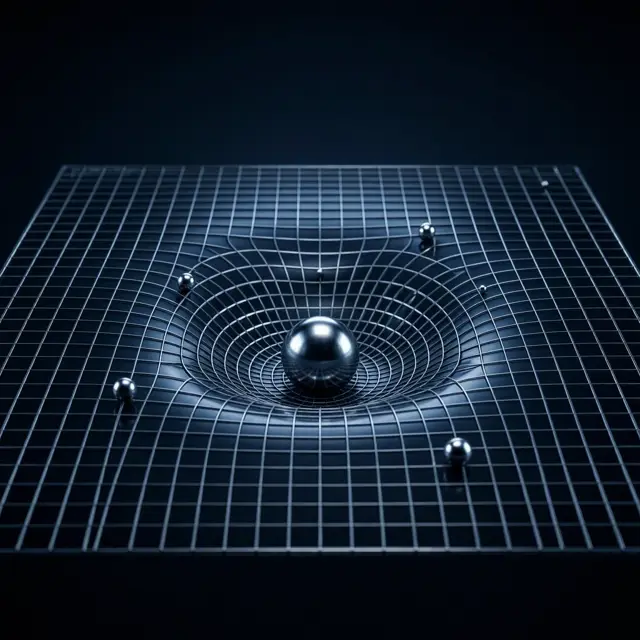
Gravity is described by the general theory of relativity, proposed by Albert Einstein in 1915, which explains gravity as the curvature of spacetime caused by the uneven distribution of mass. Objects are not being pulled so much as following the straightest available path through bent space.
The most extreme example of that curvature is a black hole, from which nothing — not even light — escapes once past the event horizon.
But relativity is not what most calculations use. For most applications, gravity is sufficiently well approximated by Newton's law of universal gravitation: an attractive force between any two bodies, proportional to the product of their masses and inversely proportional to the square of the distance between them. Newton's version is not wrong so much as an excellent approximation, and it is far easier to compute — so engineers keep using a description that was superseded over a century ago.
Weight, Tides and Weather
On the surface of a planetary body such as Earth, gravity operates toward the centre of the body — and is modified by the centrifugal effects of the body's rotation. That is why weight varies slightly depending on where you stand on the planet.
In this everyday context, gravity is what gives physical objects weight, and it drives systems that are rarely credited to it:
- Surface water waves
- Lunar tides
- A substantial contribution to weather patterns
Gravitational weight also has important biological functions. It guides the growth of plants through gravitropism — how a root knows to go down and a shoot to go up — and influences the circulation of fluids in multicellular organisms. A force usually discussed in terms of planets is also the reason a seedling can orient itself in the dark.
The Piece That Will Not Fit
Gravity remains the outstanding unsolved problem in fundamental physics, and the reason is a mismatch of frameworks rather than a lack of data.
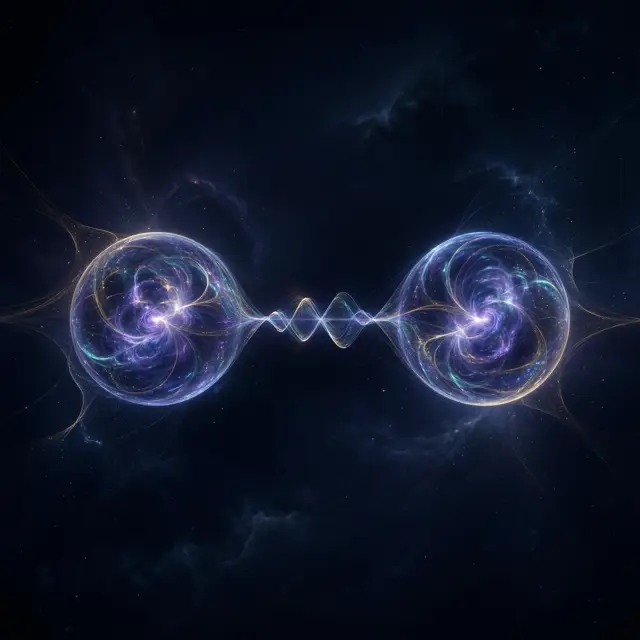
Scientists are looking for a theory that describes gravity within quantum mechanics — quantum gravity — which would unify gravity with the other known fundamental interactions inside a single mathematical framework, a theory of everything.
The difficulty is that the two best-tested theories in science do not agree about what gravity is. General relativity treats it as smooth geometry; quantum mechanics describes everything else in discrete packets and probabilities. Both work superbly in their own domain, and both are needed exactly where the other breaks down — inside black holes, and at the beginning of the universe. That gap has stayed open for a century.