The Cells That Refused to Die
Before 1951, human cells grown in a laboratory survived a few days and then died. That was simply the ceiling on what biology could study.
HeLa broke it. The line came from cervical cancer cells taken on 8 February 1951 from Henrietta Lacks, a 31-year-old African-American woman being treated at Johns Hopkins Hospital. She died of her cancer on 4 October that year. Her cells did not.
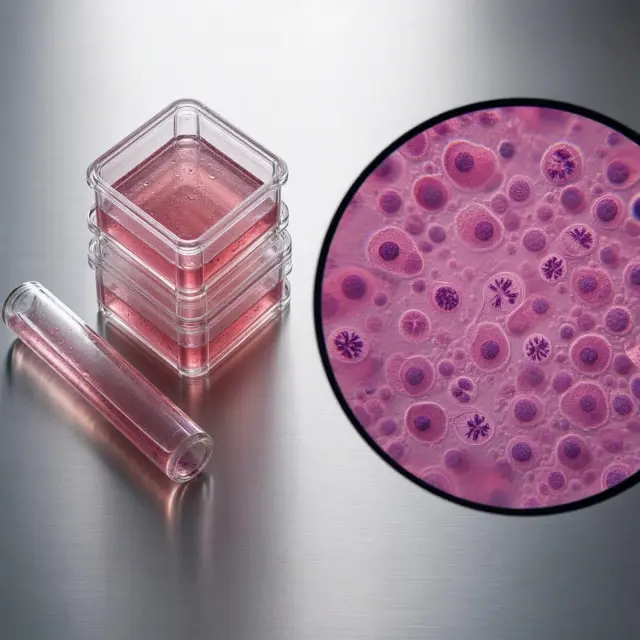
The cell biologist George Otto Gey found they could be kept alive, and his lab assistant Mary Kubicek cultured them using the roller-tube technique. They grew robustly, doubling every 20 to 24 hours, while every previous specimen had died out. It was the first human cell line to prove successful in vitro. Following the lab's naming custom, the culture was called after the first two letters of each of her names: He plus La. Cells are called immortal when they can divide without limit, and the total number of HeLa cells grown since far exceeds the number that were ever in Lacks's body.
Taken Without Asking
The samples were collected without Lacks's knowledge, which was common practice in the United States at the time. Her first treatment was performed by Lawrence Wharton Jr., who took tissue from her cervix without her consent, and neither she nor her family ever gave permission for the cells to be harvested or used.
Legally, nothing had gone wrong by the standards of the day. There was no requirement to inform patients or relatives, because material discarded or obtained during surgery, diagnosis or therapy was considered the property of the physician or the institution.
Gey himself was not commercially motivated. He freely donated the cells, along with the tools and processes his lab had developed, to any scientist who asked, purely for the benefit of science. The cells were commercialized later, though never patented in their original form. For two decades her identity was lost in the process: until a 1973 query printed in the journal *Nature* recovered her real name, the line was widely and incorrectly attributed to a "Helen Lane" or "Helen Larson".
What These Cells Made Possible
HeLa cells were the first human cells successfully cloned, in 1955, by Theodore Puck and Philip I. Marcus. From there they went nearly everywhere in biology.
Their first great use was polio. Jonas Salk needed to test the first polio vaccine, and HeLa cells were easily infected by the poliovirus and visibly died when infected, so results came quickly. Demand was so high that in spring 1953 a cell culture factory was established at Tuskegee University purely to mass-produce them, and less than a year later Salk's vaccine was ready for human trials.
The list kept growing: parvovirus, HIV, Zika, mumps and herpes research all ran through HeLa. Richard Axel found that adding the CD4 protein to HeLa cells allowed them to be infected with HIV so the virus could be studied. Most poignantly, in the 1980s Harald zur Hausen found HeLa cells contained HPV-18, later identified as the cause of the aggressive cancer that had killed Lacks. His work linking HPV to cervical cancer won a Nobel Prize and led directly to HPV testing and the vaccines that now cut cervical cancer rates by around 90% in those vaccinated before age 17.
The Family Left Outside
The context of how the cells were obtained matters. Johns Hopkins was the only hospital in the Baltimore area where African American patients could receive free care, and patients treated in that segregated section frequently became research subjects without knowing it.
Lacks's family had no access to her patient files and no say in who received HeLa cells or what they were used for. As the cells spread through science and industry, her relatives received no financial benefit and continued to live with limited access to healthcare themselves.
The one time researchers did come to them, it went badly. In 1973 staff at Johns Hopkins discovered that HeLa cells could travel through the air and contaminate other cell cultures, and a staff physician contacted the family seeking DNA samples to work out which cultures were affected. The family never understood the purpose of the visit and were distressed by what they understood the researchers to be telling them.
The Rules That Changed Afterwards
Lacks's case is one of many examples of the absence of informed consent in twentieth-century medicine, and it helped force the rules to change.
The legal question of who owns a tissue sample reached the Supreme Court of California in *Moore v. Regents of the University of California* in 1990, which ruled that a person's discarded tissue and cells are not their property and can be commercialized. Her case then influenced the establishment of the Common Rule in 1991, which requires doctors to tell patients if they intend to use details of their case in research and to give them a choice about it. Samples are now identified by code numbers rather than donors' initials, and Johns Hopkins established a joint committee with the NIH and several of Lacks's family members to decide who may access her genome.
The compensation question is only being settled now. In 2021 her estate sued over the unauthorized sale of HeLa cells, reaching a settlement with Thermo Fisher Scientific announced in August 2023, with Novartis settling in 2026 and further lawsuits still pending.