A Squirrel Colder Than Ice
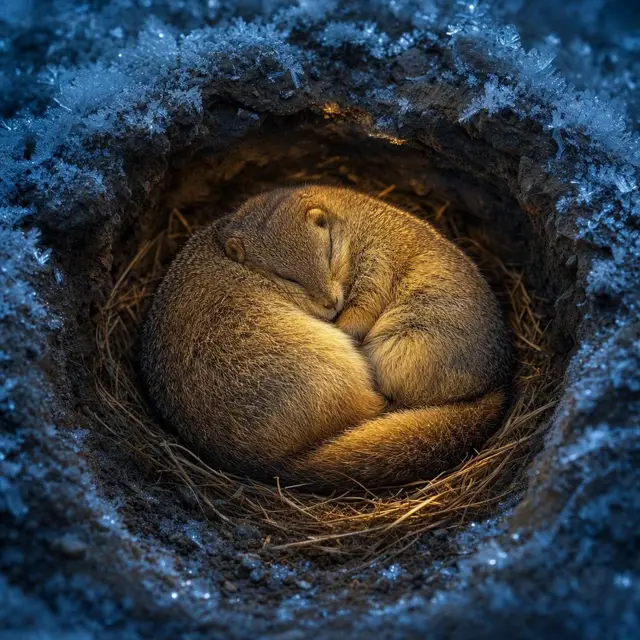
Hibernating Arctic ground squirrels can let their belly temperature drop as low as -2.9 °C (26.8 °F). They can keep it below zero for more than three weeks at a time. Only their head and neck stay at 0 °C (32 °F) or above.
Hibernation is a way to save energy when food runs short. The animal lowers its metabolic rate, and its body temperature falls with it. Breathing and heart rate slow down a lot. It can last days, weeks or months, depending on the species, the weather, the time of year and the animal's condition.
Strangely, hibernators don't stay cold all winter. Their long spells of torpor are broken up by short wake-ups, when body temperature and heart rate go back to normal. Nobody is fully sure why. One favored idea is that they build up a "sleep debt" and must warm up now and then to actually sleep. Evidence from the Arctic ground squirrel supports this.
Bears That Skip the Bathroom for Months
For years, scientists argued over whether bears truly hibernate. A bear's body temperature drops only 3 to 5 °C (5 to 9 °F). Other hibernators often drop 32 °C (60 °F) or more. Research on captive black bears in 2011, and on brown bears in 2016, settled it: bears count.
A hibernating bear does not eat or drink. It lives off stored fat. It recycles its proteins and urine, so it can stop urinating for months and still avoid losing muscle. It stays hydrated with metabolic water made inside its own body. Its bones stay strong too, and it does not get osteoporosis.
A 2016 study followed 14 brown bears over three winters. The bears entered their dens when snow arrived and the air hit 0 °C (32 °F). But their heart rate and body temperature had started to drop weeks before that. Female black bears even hibernate through winter to give birth, and mothers lose 15 to 27% of their weight.
A Lemur That Hibernates in the Heat
For a long time, no primate or tropical mammal was known to hibernate. Then scientists found the fat-tailed dwarf lemur of Madagascar. It hibernates in tree holes for seven months of the year.
Here is the twist. Winter temperatures in Madagascar sometimes rise above 30 °C (86 °F). So hibernation is not only a trick for surviving cold. It is really about saving energy. The lemur's body also depends on its tree hole. In a poorly insulated hole, its body temperature swings up and down with the air. In a well insulated one, its temperature stays fairly steady and it wakes up at regular times.
Not every animal plays by the same rules. Animals called obligate hibernators, like many ground squirrels and European hedgehogs, hibernate every year no matter the weather or food. Others hibernate only when they are cold or hungry, like the chipmunk. Even prairie dogs split. The white-tailed prairie dog always hibernates, while its close relative, the black-tailed prairie dog, does it only when needed.
Swallows, Sharks and Frogs That Freeze
People in ancient times believed swallows hibernated. Gilbert White's 1789 book The Natural History of Selborne showed the belief was still around in his day. Today we know most birds don't hibernate. They use shorter rests instead. One known exception is a bird called the common poorwill.
Cold-blooded animals such as fish, reptiles and amphibians can't lower their body temperature on purpose the way mammals do. Their winter rest is often called brumation. Some fish, amphibians and reptiles can actually freeze and then "wake" up in spring. They have evolved tricks such as antifreeze proteins to survive it.
Some old ideas turned out to be wrong. People once thought basking sharks sank to the floor of the North Sea and slept through winter. In 2003, research by David Sims showed they actually travel long distances, following the richest patches of plankton. Meanwhile, epaulette sharks can survive three hours without oxygen. Goldfish, wood frogs and bar-headed geese can also cope with very little oxygen.
From Ancient Ancestors to Mars
Hibernation may be very old. The earliest suggested case is Thrinaxodon, an ancestor of mammals that lived roughly 252 million years ago. Scientists now think hibernation likely evolved at the same time as endothermy, not after it, as was once believed.
Size matters too. As animals get bigger, they have less surface area for their volume, so it takes less energy to stay warm. That makes hibernation less useful, which is why most large mammals and birds lost the ability. Bears are one of the very few exceptions.
Researchers are now studying how to put humans into hibernation. It could help seriously ill people survive until treatment is available. It is also being considered for long space trips, such as missions to Mars. Oddly, something close already happened. In 1900, The British Medical Journal described a practice called "Lotska" among Russian peasants in Pskov. Short of food, families slept around the stove for six months, waking once a day for some bread and water.