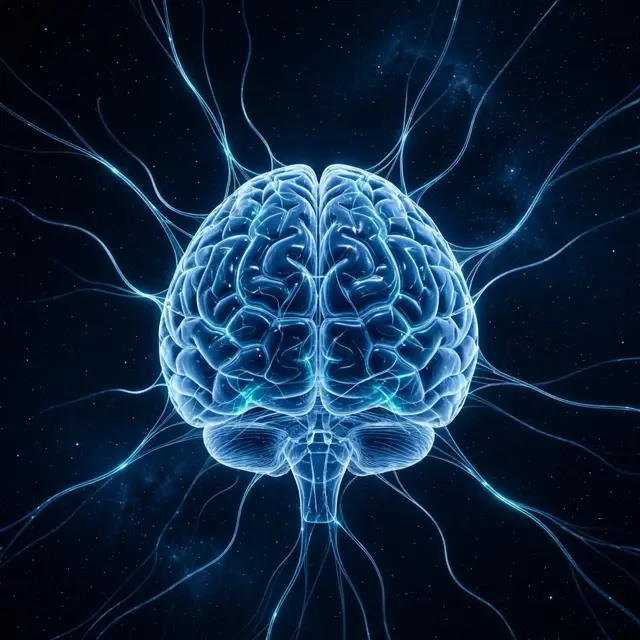
Eighty-Six Billion Cells in One Organ
The human brain contains more than 86 billion neurons, plus a more or less equal number of other cells. That second half is easy to miss: the glial cells that support the neurons are roughly as numerous as the neurons themselves.
Brain activity is possible because of how those cells connect. Neurons link into neural pathways, then circuits, then elaborate network systems, and the whole thing runs on neurotransmission: neurons release neurotransmitters in response to nerve impulses.
The brain is the central organ of the nervous system, and together with the spinal cord it makes up the central nervous system. It controls most of the body's activities, processing and integrating information from the senses and coordinating the instructions sent back out.
Four Lobes, Four Different Jobs
The brain has three main parts: the cerebrum, the brainstem and the cerebellum. The cerebrum is the largest, and it splits into two hemispheres.
Each hemisphere has an inner core of white matter and an outer surface, the cerebral cortex, made of grey matter. The cortex itself has an outer layer called the neocortex, built from six layers of neurons, and an inner allocortex with three or four.
Each hemisphere divides into four lobes: frontal, parietal, temporal and occipital. The frontal lobe handles executive functions, including self-control, planning, reasoning and abstract thought. The occipital lobe is dedicated to vision. The two hemispheres are broadly similar, but language tends to sit on the left and visual-spatial ability on the right, and they are joined by nerve tracts, the largest being the corpus callosum.
The Fluid It Floats In
Inside the cerebrum sits the ventricular system: four interconnected chambers where cerebrospinal fluid is produced and circulated.
That fluid does something remarkable. The brain is suspended in it, which means it effectively floats rather than resting on the base of the skull under its own weight.
Protection comes in layers. The skull encloses it, the cerebrospinal fluid cushions it, and the blood-brain barrier isolates it from the bloodstream, screening what is allowed to cross. Beneath the cortex sit structures including the thalamus, hypothalamus, pineal gland and pituitary gland, along with limbic structures such as the amygdalae and hippocampi. Because these lie off the midline, they come in pairs: two hippocampi, two amygdalae.
What Can Go Wrong
All that protection is not absolute. The brain remains susceptible to damage, disease and infection.
Damage can come from trauma, or from a loss of blood supply, which is a stroke. It is also vulnerable to degenerative disorders including Parkinson's disease, dementias such as Alzheimer's disease, and multiple sclerosis. Psychiatric conditions including schizophrenia and clinical depression are thought to be associated with brain dysfunctions.
Tumours can occur too, both benign and malignant, and most of them originate elsewhere in the body before reaching the brain rather than starting there.
That last detail is worth sitting with. The organ most carefully walled off from the rest of the body is still most often invaded from it, which is a reminder that the skull, the fluid and the barrier are defences rather than guarantees.
From Phrenology to Brain Scans
Studying the brain has its own vocabulary. Neuroanatomy is the study of its structure, and neuroscience the study of its function.
The methods have changed enormously. Traditionally, much was learned from examining specimens from other animals under a microscope. The medical histories of people with brain injuries provided some of the sharpest insights into what individual regions actually do.
Modern work leans on imaging: functional neuroimaging and electroencephalography, or EEG, recordings. Not every attempt aged well. In the 19th century the pseudoscience of phrenology tried to map personality traits onto regions of the cortex. Meanwhile philosophy of mind has spent centuries on a question none of the scanners have answered: the nature of consciousness and the mind-body problem.