A Camera Made of Living Tissue
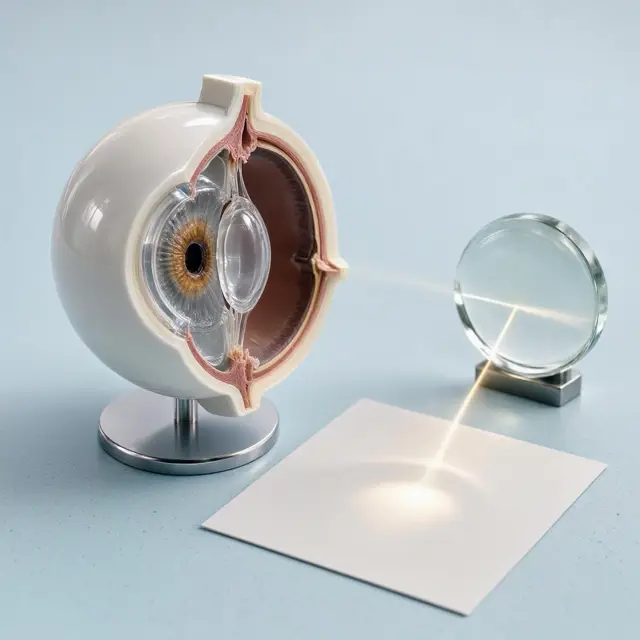
Your eye works a lot like a camera. Light first passes through the cornea, the clear front window of the eye, which does most of the focusing. Then it goes through the pupil, a hole whose size is controlled by the coloured ring around it, the iris.
Next comes the lens, which fine-tunes the focus. Finally, the light lands on the retina at the back of the eye, where the image is picked up and sent to the brain through the optic nerve.
The pupil works just like a camera's opening. It is usually about 4 millimetres wide, but it can shrink to 2 millimetres in bright light and widen to 8 millimetres in the dark. The adult eye is only about 24 millimetres across.
Rods for the Dark, Cones for Colour
The retina is packed with cells that turn light into electrical signals. There are two main kinds, and they share the work.
Rods handle dim light. They let you see in the dark, but only in shades of grey and without much detail. Cones need brighter light, but they give you sharp detail and colour.
A third, more recently discovered type of cell helps too. It responds to all light levels and helps control how much light reaches the retina. It also helps set your body clock, known as your circadian rhythm, by affecting the sleep hormone melatonin. So your eyes do more than let you see. They also help tell your body when it is day and when it is night.
The Blind Spot in Every Eye
Here is something strange: each of your eyes has a spot where it cannot see anything at all. It is where the optic nerve leaves the eye, and there are no light-sensing cells there. This blind spot sits about 15 degrees to the side of where you are looking, toward your nose, and is roughly 7.5 degrees high and 5.5 degrees wide.
That is a real gap in your view of the world, sitting in every eye you have.
Your eyes also never stop moving. Even when you stare at one spot, they make tiny drifts and flickers. This keeps fresh light falling on the sensing cells. Without these movements, the cells would stop sending signals, and what you are looking at would fade from view.
From Starlight to Sunshine
The eye can handle an astonishing range of light. The brightest light it can use for normal seeing is about one hundred trillion times brighter than the dimmest light it can detect.
Adjusting to darkness takes time, though. When you walk into a dark room, the first changes happen in about four seconds. But the full shift, called dark adaptation, is about 80% complete after thirty minutes. A sudden flash of light forces the whole process to start again.
Together, your two eyes can see about 214 degrees from side to side. Babies' eyes grow fast too, from about 16 millimetres wide at birth to full adult size by age 12.
Why Most Eyes Are Brown
Brown is by far the most common eye colour in the world. About 79% of people have brown eyes. They get their colour from a lot of melanin, a dark natural pigment, in the iris. In many parts of the world, brown is almost the only eye colour you will see.
Blue eyes are much rarer, found in about 8 to 10% of people around the world. They are most common in northern and eastern Europe, especially around the Baltic Sea.
Eye colour was once thought to be passed down in a simple way. Scientists now know it is controlled by several genes working together, a type of trait called polygenic.