Born with More Bones Than You Keep
Here is a strange fact about your body: you had more bones as a baby than you do now. A newborn has around 270 bones. By adulthood, that number drops to around 206, because some bones fuse together as we grow. Nothing is lost. The pieces simply join up.
All that bone adds up. The skeleton makes up about 14% of total body weight, roughly 10 to 11 kg for an average person. It reaches its greatest mass between the ages of 25 and 30.
The human skeleton differs less between men and women than it does in many other primates. Still, there are small differences. Female bones tend to be smaller and less robust within a given population, and the female pelvis is shaped differently to make childbirth easier.
Two Halves of One Frame
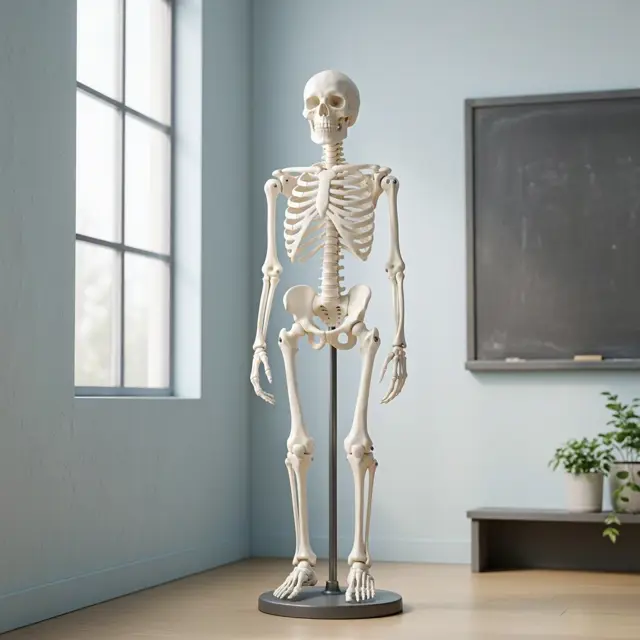
Anatomists split the skeleton into two parts. The axial skeleton runs down the middle of the body and has 80 bones. It includes the spine, which has 32 to 34 bones depending on how you count the lowest ones, plus 12 pairs of ribs, the breastbone, and 22 bones in the skull.
This central column is what keeps us upright. It carries the weight of the head, the trunk, and the arms down to the legs at the hip joints. Many ligaments support the spine, and a group of back muscles helps with balance.
The appendicular skeleton hangs off that central frame and has 126 bones. It includes the shoulder girdles, the arms, the pelvis, and the legs. These bones make walking and moving around possible, and they help protect the organs of digestion, excretion, and reproduction.
Six Jobs at Once
Your skeleton does far more than hold you up. It has six major jobs: support, movement, protection, making blood cells, storing minerals, and helping control hormones. Without the rib cage and the muscles between the ribs, for example, the lungs would collapse.
Blood cells are made inside bone marrow, a process called haematopoiesis. In children it happens mostly in long bones like the thigh bone. In adults it moves mainly to the pelvis, skull, spine, and breastbone.
Bones are also a storage bank. They hold calcium, and marrow stores iron. Yet bone is not pure calcium. About 70% of it is hydroxyapatite, a mineral made of calcium, oxygen, phosphorus, and a little hydrogen. Bone cells even release a hormone called osteocalcin, which helps control blood sugar and fat storage and boosts the body's insulin.
When Bones Wear Down
Many things can go wrong with the skeleton. One of the most common problems is osteoporosis, where bones lose mineral density and break more easily. It often has no symptoms until a bone breaks. That is why people with risk factors often get special scans to check their bone density.
Osteoporosis is most common in women after menopause, but men can get it too. Treatment includes quitting smoking, drinking less alcohol, exercising regularly, and eating well. Calcium and vitamin D may also help.
Another common condition is scoliosis, a sideways curve of the spine that can look like a "C" or an "S" on an x-ray. It shows up most during the teenage years and is more common in females. Arthritis affects the joints instead. In its most common form, the cartilage between bones slowly wears away, making movement stiff and painful.
Counting Bones Through the Ages
People have been counting bones for a very long time, and they did not always agree. The Sushruta Samhita, an ancient Indian medical text, speaks of 360 bones. Other Indian surgical books counted only 300. Different schools disagreed partly because one counted 32 tooth sockets, and they also argued about when cartilage should count as bone, which modern anatomy does not do.
In ancient Alexandria, Herophilos is credited as a pioneer of the field. His works are lost, but later writers such as Galen often cited him.
During the Renaissance, Leonardo da Vinci studied the skeleton, though his work was not published in his lifetime. Then came Vesalius, regarded as the founder of modern anatomy. His book, De humani corporis fabrica, was full of skeleton drawings. It also fixed old mistakes, such as Galen's claim that the lower jaw was two bones instead of one.