44 Flashes Every Second
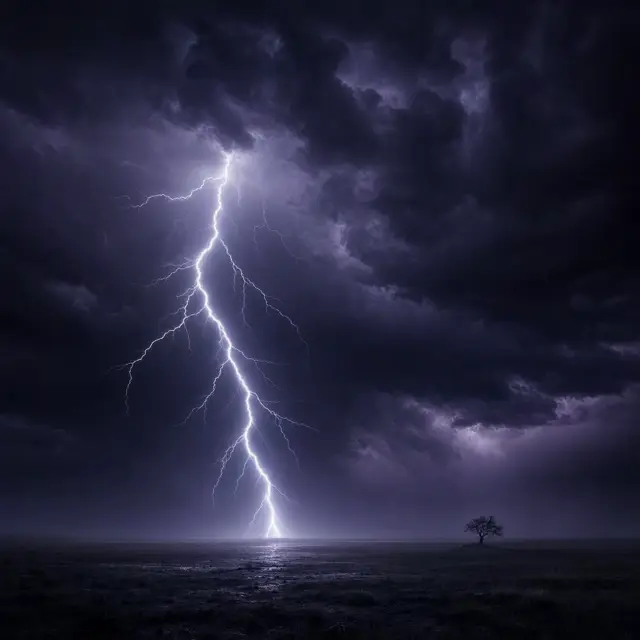
Lightning is striking somewhere on Earth about 44 times every second. That adds up to nearly 1.4 billion flashes a year, and about 70 percent of them happen over land in the tropics.
Each flash lasts about half a second, but it is really a chain of much shorter strokes, each one lasting only 60 to 70 millionths of a second. In that tiny window, the air around the flash heats up to about 30,000 °C. The energy released by a single flash ranges from about 200 megajoules to 7 gigajoules.
Some places get far more than their share. Over Lake Maracaibo in Venezuela, a pattern known as Catatumbo lightning produces about 250 bolts a day, on about 297 days a year. No place on Earth sees lightning more often. Other hotspots include the mountains of the eastern Democratic Republic of the Congo, Singapore, and a stretch of Central Florida nicknamed Lightning Alley.
How a Storm Charges Itself
Scientists are still working out the full details, but the basic idea is agreed on: a thunderstorm builds up electric charge by knocking bits of ice together.
In the middle of the storm, air rushes upward and the temperature sits between −15 and −25 °C. Here you find a mix of tiny water droplets that stay liquid below freezing, small ice crystals, and soft hail called graupel. The rising air carries the light ice crystals up, while the heavier graupel hangs in the middle of the cloud or falls.
As they pass each other, they collide. The ice crystals pick up a positive charge and the graupel picks up a negative one. The crystals are carried to the top, so the top of the cloud becomes positive while the middle and lower parts become negative.
When a strike to the ground begins, a stepped leader works its way down from the cloud. A streamer rises from the ground to meet it, and the moment they connect, the flash races through.
The Thunder Trick
Thunder is what all that heat sounds like. The flash heats the air so fast that the gas expands outward in a shock wave, and that is the boom you hear.
The long rumble comes from the length of the bolt. Sound starts from every point along the channel, so the parts farther from you arrive a little later. That stretches one crack into a rolling growl.
Because light travels so much faster than sound, you can work out roughly how far away a strike is. Count the seconds between the flash and the thunder. A three second gap means the lightning is about 1 kilometre away, and five seconds means roughly 1.6 kilometres, or a mile. If the thunder comes almost instantly, the strike was very close, and you might even smell ozone.
You can also see lightning without hearing it. A storm can be seen from more than 160 kilometres away, but its thunder only carries about 32 kilometres.
Megaflashes and Lightning on Other Worlds
Most bolts are short, but a few are enormous. An unusually long flash is called a megaflash, one that stretches about 100 kilometres or more across the sky.
In 2025, scientists found that a flash in October 2017 had run 829 kilometres across Texas and Kansas, touching the ground in five states. Another flash, over Uruguay and northern Argentina in June 2020, lasted 17.1 seconds.
Lightning is not just an Earth thing, either. It has been seen on Jupiter and Saturn, and probably happens on Uranus and Neptune too. Lightning on Jupiter is far more powerful than ours. In 2025, researchers reported a possible sign of lightning on Mars, picked up by a microphone on NASA's Perseverance rover.
Back home, lightning even does useful work. It turns nitrogen in the air into nitrates, which rain carries down to help plants grow. And although it can be deadly, about 90 percent of people struck by lightning survive.