The Only Big Cat That Lives in a Team
Almost every wild cat on the planet hunts alone. The lion does not. It is a social species that forms groups called prides, and that single difference shapes everything about how it lives.
A pride is built around related females and their cubs, plus one adult male or a few, who are unrelated to the females. The females stay. The males are the outsiders who arrive, and adult males often have to compete just to keep or gain their place in the group.
Groups of female lions usually hunt together. That teamwork is what lets a pride bring down prey far larger than any single cat could handle, which is mostly medium-sized and large hooved mammals.
Built for the Open Grass
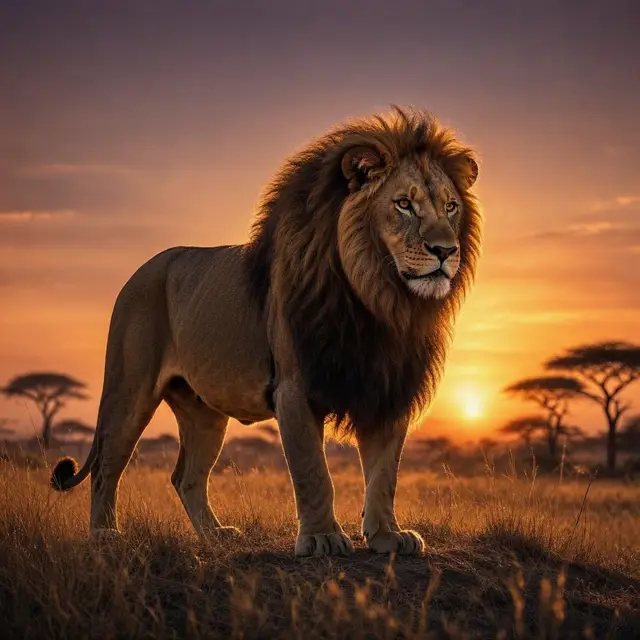
The lion, Panthera leo, is a large cat with a muscular, broad-chested body, a short rounded head, round ears, and a dark hairy tuft right at the tip of its tail. It lives in grasslands, savannahs and shrublands.
It is sexually dimorphic, meaning males and females look clearly different. Adult males are larger, and they carry the mane that runs from the head down over the shoulders and chest.
One habit sets it apart from its relatives: the lion is usually more active in daylight than other wild cats. But that is flexible. Where lions are persecuted by people, they shift their schedule and become active at night and at twilight instead. As an apex predator and a keystone predator, its presence shapes the whole ecosystem around it.
From Southeast Europe to a Single Indian Forest
During the Neolithic period the lion ranged across Africa and Eurasia, all the way from Southeast Europe to India. That is a staggering territory, and almost none of it is left.
Today the lion is reduced to fragmented populations in sub-Saharan Africa, plus one surviving population in western India. It has been listed as Vulnerable on the IUCN Red List since 1996, because populations in African countries have fallen by roughly 43% since the early 1990s.
The cause of the decline is not fully understood, but two pressures stand out: habitat loss and conflict with humans. Outside designated protected areas, lion populations are simply untenable.
Why We Put Lions on Flags
No animal has been carved, painted and printed more often. The lion appears in sculptures and paintings, on national flags, and throughout literature and film. It is one of the most widely recognised animal symbols in all of human culture.
The meaning has been remarkably consistent across the world: power and royalty. Lions figure prominently as symbols and as deities in ancient religions, in cultures that had never met each other.
The fascination went beyond art. Lions have been kept in menageries since the time of the Roman Empire, and since the late 18th century they have been the key species that zoological gardens across the world wanted on display.