Stones That Pulled Iron
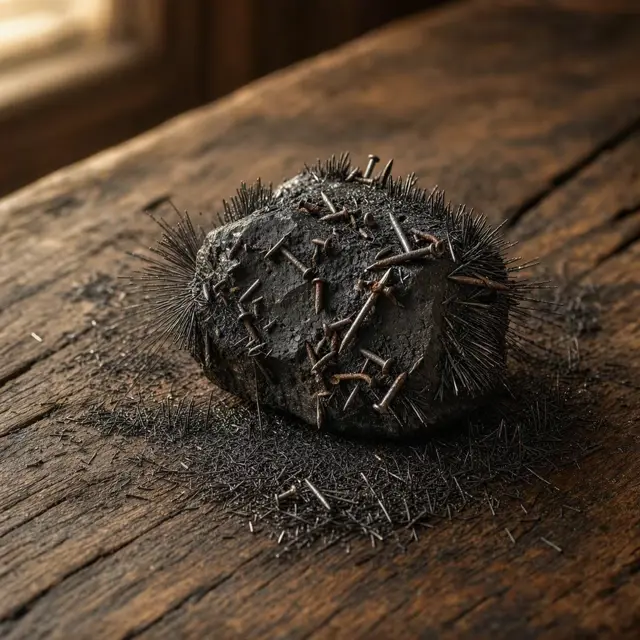
Long before anyone knew what an atom was, people noticed that certain dark rocks could pull iron toward them. Each one was a lodestone, a piece of the mineral magnetite that had become magnetized on its own. The word magnet comes from a Greek phrase meaning the Magnesian stone.
Aristotle credited the Greek thinker Thales of Miletus, who lived from about 625 to 545 BCE, with the first real discussion of magnetism. In ancient India, the medical text Sushruta Samhita describes using magnetite to remove arrows stuck in a person's body.
China has an even longer paper trail. A book from the 4th century BCE mentions magnetism, and a 1st-century work says simply that a lodestone attracts a needle. In the 11th century, the scientist Shen Kuo was the first to write about the magnetic needle compass. By the 12th century, the Chinese used lodestone compasses to find their way, including a spoon carved from lodestone so that its handle always pointed south.
How Earth Turned Out to Be a Magnet
Europe caught on later. Alexander Neckam described the compass and its use for navigation by 1187. In 1269, Peter Peregrinus wrote the oldest surviving book on the properties of magnets. In 1282, the Yemeni scholar Al-Ashraf Umar II also wrote about magnets and dry compasses.
The big leap came in 1600. William Gilbert ran experiments with a small model Earth he called the terrella. He concluded that the Earth itself is magnetic, and that this is why compasses point north. Before that, some people believed the pole star Polaris, or a huge magnetic island at the North Pole, was doing the pulling.
Then, in 1819, Hans Christian Ørsted saw a compass needle twitch near a wire by accident. It showed that an electric current can create a magnetic field. In 1831, Michael Faraday found that a changing magnetic field can create a voltage in a loop of wire. From around 1861, James Clerk Maxwell pulled these ideas together, uniting electricity, magnetism, and the science of light into one field called electromagnetism.
Everything Is a Little Bit Magnetic
Here is the surprise: every substance shows some kind of magnetism. Only a few are strongly pulled, though. These ferromagnetic materials, mainly iron, cobalt, nickel, and their alloys, can even be turned into permanent magnets. They cause almost all the magnet effects we notice in daily life.
Other materials react in quieter ways. Some are paramagnetic, like aluminium and oxygen, which are weakly pulled toward a magnet. Others are diamagnetic, like copper and carbon, which are weakly pushed away. Materials such as chromium have a more complicated relationship with magnetic fields. These forces are usually too weak to feel and show up only on lab instruments, which is why we call such things non-magnetic.
That weak push can still matter. Water is diamagnetic, and many living things are mostly water. So extremely strong magnetic fields can actually push living things away. One more rule holds everywhere: the strength of a magnetic field always drops as you move farther from its source.
Tiny Magnets Inside Every Atom
Where does all this come from? Mostly from electrons. Each electron acts like a tiny magnet. In most materials, electrons pair up with partners pointing the opposite way, so their effects cancel out. Even unpaired electrons often point in random directions, so the material stays non-magnetic overall.
In a ferromagnet, unpaired electrons prefer to line up with each other. They gather into small regions called magnetic domains, each pointing roughly one way. Put the material in a strong field and the domains that match it grow. Take the field away, and many stay lined up. That is how a permanent magnet forms. Heat it past its Curie temperature, though, and the order falls apart and the magnetism is lost.
Magnets also follow a stubborn rule: poles come in pairs. Cut a bar magnet in half and you get two smaller magnets, each with a north and a south pole. A lone pole, called a magnetic monopole, would be a whole new kind of object. Some theories predict it, but despite searches since 1931, none has ever been found.
Magnets With an Off Switch
An electromagnet makes its field from an electric current, usually running through many tight turns of wire wrapped around an iron core. Turn off the current and the field disappears. That makes it easy to control, but unlike a permanent magnet, it needs a steady supply of power to keep working.
Electromagnets hide inside many everyday machines: motors, generators, loudspeakers, hard disks, and MRI scanners. In industry, big ones pick up and move heavy scrap iron and steel. The link between electricity and magnetism runs so deep that Einstein's theory of special relativity treats them as two sides of one thing.
Nature uses magnetism too. Some living things can sense magnetic fields, an ability called magnetoception. Chitons, a type of sea mollusk, make magnetite to harden their teeth. Even humans produce magnetite in body tissue, though scientists are not sure whether it has any special job or is just a side effect of having iron in the body.