Named After a Wrong Guess
The name comes from medieval Italian, mala aria, meaning bad air. It belonged to the old idea that disease rose from swamps as a foul vapour, and the illness was also called marsh fever or ague.
The real cause is a single-celled parasite of the genus Plasmodium, carried between people by female mosquitoes of the genus Anopheles. Five species commonly infect humans, and they are not equal. P. falciparum is responsible for the vast majority of deaths.
Symptoms usually begin 10 to 15 days after an infected bite, and typically include fever, fatigue, vomiting and headaches. Severe cases can lead to jaundice, seizures or coma.
Surviving an infection buys partial protection rather than immunity. A person can be reinfected, though usually with milder symptoms, and even that protection fades over months or years without continued exposure.
The truth took a long time to find. In 1880 a French army doctor in Algeria saw the parasites inside red blood cells, the first time a protist was identified as causing disease.
A Life Cycle in Two Hosts
The parasite takes a different form at each stage, and needs both a human and a mosquito to complete its circuit.
A mosquito bite delivers the parasite in a mobile form that travels to the liver and invades liver cells. There it multiplies quietly, with a single infected cell eventually holding up to 40,000 parasites. This stage causes no symptoms at all.
After 5 to 25 days those cells break down and release a smaller form into the blood, which invades red blood cells. Each one replicates over 24 to 72 hours into 16 to 32 more, bursting the cell and starting again. Symptoms only appear once there are more than about 100,000 parasites per millilitre of blood.
Some parasites take a different path and become sexual-stage forms that wait in the blood to be picked up by the next mosquito bite, completing the loop.
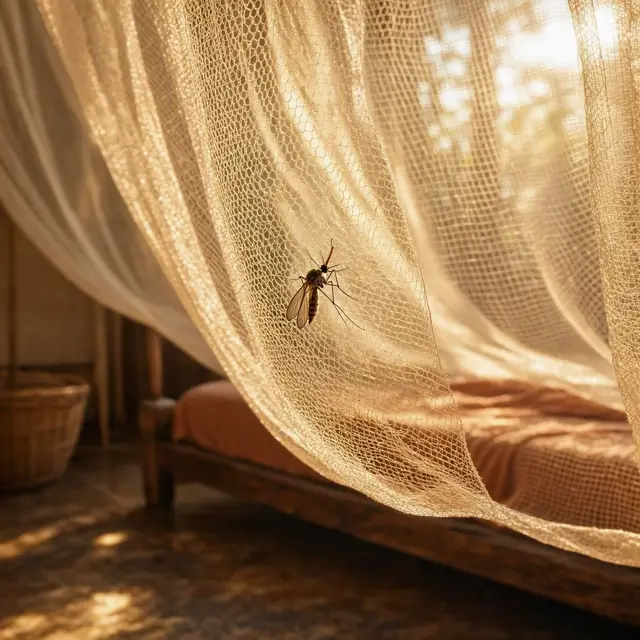
Only female mosquitoes feed on blood, and the Anopheles species prefer to feed at night. There are signs they may be adapting to bed nets by biting earlier in the evening.
From Bark to Combination Therapy
The first effective treatment came from the bark of the cinchona tree, which grows on the slopes of the Andes, mainly in Peru. Indigenous Peruvians made a tincture from it to control fever.
Jesuits brought the remedy to Europe around 1640, and by 1677 it was listed in the London Pharmacopoeia as a treatment for malaria. Only in 1820 did two French chemists isolate and name the active ingredient, quinine. It stayed the main medicine until the 1920s, and in British-occupied India the gin and tonic may have started as a way of taking it.
Chloroquine replaced quinine in the 1940s, and then the parasite caught up. Resistance appeared in Southeast Asia and South America in the 1950s and spread globally by the 1980s.
Treatment guidelines since 2001 require two drugs at once, one of them derived from artemisinin, specifically to slow resistance from developing. Partial resistance to artemisinin emerged in Southeast Asia in 2001 anyway, and has since reached parts of Africa.
Written Into Human Blood
Because it has killed so many for so long, malaria has applied the greatest selective pressure on the human genome in recent history. Several inherited traits offer some protection, including sickle cell trait and certain thalassaemia traits.
The sickle cell case shows the bargain clearly. Carrying one copy of the altered gene gives resistance to malaria without serious anaemia, because infected cells distort and are cleared from circulation sooner. Carrying two copies causes sickle cell anaemia. The trait persists in malarial regions because the single-copy version is an advantage.
Prevention is more mundane and very effective. Insecticide-treated nets are about twice as good as untreated ones and give over 70 percent protection compared with no net.
Vaccines took much longer, because the parasite changes its surface at every stage. Two are now approved: one endorsed in 2021 and a second in 2023 that cut cases by 75 percent where transmission is seasonal. Between 2000 and 2015 global deaths fell from about 839,000 to 438,000, though progress has since stalled.