A Country Built on an Old Sea Fort
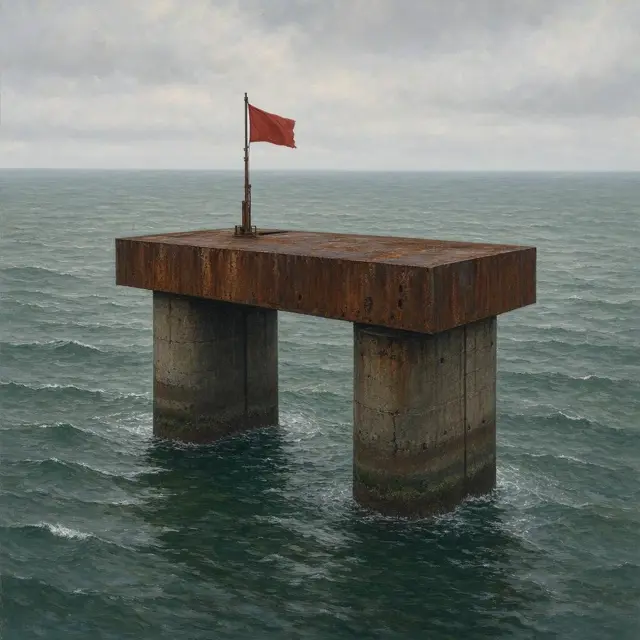
In 1967, Paddy Roy Bates moved onto HM Fort Roughs, an old World War II platform in the North Sea about 12 kilometres off the coast of the United Kingdom. He planned to run a pirate radio station from it, but he never did. Instead, he declared the fort independent and named it the Principality of Sealand.
Sealand still has a prince. Michael Bates took over the title in 2012. The tiny sea fort even has its own national football team, founded in 2004. Two years later, the team joined the N.F.-Board, a federation for unrecognised states, regions and micronations that are not allowed to join FIFA.
Sealand is the best known example of a micronation. That is a place whose founders say it is an independent country, even though no real country recognises it. Micronation fans call real countries macronations. Most of the time, the macronations whose land is claimed simply ignore these little states, because what they do is too small to argue about.
Rafts, Reefs and Platforms at Sea
Some of the boldest micronations were built on water. In 1964, writer Leicester Hemingway made a bamboo raft from steel, iron piping and rock and declared it a nation. He had it towed 9.7 kilometres off the coast of Jamaica and argued that it was technically a fully sovereign island. A cyclone destroyed the raft within a few years.
In 1968, Giorgio Rosa declared a platform in the Adriatic Sea, first built as a tourist attraction, to be the Republic of Rose Island. It had its own currency, a post office and shops. In 1969, the Italian Navy used explosives to destroy it, saying it was a way to make money from tourists while avoiding taxes. Netflix turned the story into a film in 2020.
In 1972, a libertarian project went further and built a small artificial island on a remote reef by bringing in sand. Troops from Tonga took it over that same year and destroyed the island, but for a short time it was a media sensation. Trying to build permanent homes on the open sea like this is called seasteading.
Wheat, Roadblocks and a Wind Turbine
People start micronations for many reasons: political protest, art, experiments, personal fun, and sometimes to do things that would normally be illegal. Australia has a surprisingly high number of them. The first was the Principality of Hutt River, declared in 1970 by farmer Leonard Casley after a dispute over wheat production quotas. It lasted until 2020.
In 1982, residents of the Florida Keys founded the Conch Republic after the US Border Patrol set up a roadblock on one of the only two roads linking the Keys to the mainland. The roadblock was soon removed, but the republic lives on as a tongue-in-cheek way to boost tourism. In 1986, inventor Dean Kamen declared the Kingdom of North Dumpling on his own private island after local officials refused to let him build a wind turbine. He wrote a constitution and created a flag, a currency and a national anthem.
In Japan, a 1981 novel about a village breaking away from Japan inspired many real villages to declare independence, mostly to show off their local culture and crafts. One group of them, the Ginko Federation, even held its own Olympic games in 1986. In 1997, the Užupis neighbourhood of Vilnius, Lithuania, declared itself a playful republic of laid-back artists.
Stamps, Passports and a Cabinet of Almost-Countries
Micronations copy real countries in almost every way. They have governments, constitutions and laws, and some hold national elections. Many issue flags, coins, banknotes, stamps and passports, and hand out medals and noble titles. None of these are recognised abroad, but some micronations make money selling them to tourists as souvenirs. Well-made micronation coins and stamps have even become prized by collectors.
They practise diplomacy with each other, too. Micronations sign treaties and non-aggression pacts, and some groups of micronations have as many as 80 member states. The MicroCon convention has brought micronationalists together since 2015, when the first one was held in Anaheim, California. Back in 2000, two micronations even hosted an online Olympic Games, and six micronations competed.
Real governments noticed long ago. In 1973, an office of the US State Department kept a file cabinet for "countries which are only partially real." The study of micronations has its own name: micropatrology. Today thousands of micronations exist only online, and on MicroWiki, some country pages are said to be longer than the pages for real nations on Wikipedia.
Claims on Deserts, Ice and Outer Space
Some micronations claim land nobody else wants. Bir Tawil, a stretch of land between Egypt and Sudan, is terra nullius, which means no country claims it. In June 2014, Virginia farmer Jeremiah Heaton travelled there and declared the Kingdom of North Sudan. He said he did it to keep a promise to make his daughter a princess. He also proposed a national currency, a capital city and an international airport, all paid for by crowdfunding.
Others aim somewhere colder. Several micronations, such as the Grand Duchy of Westarctica, claim parts of Antarctica, though none has managed to set up a permanent home there because it is so remote. Others claim small pockets of land on the banks of the Danube river that have no infrastructure and sit on a floodplain.
Then there is space. A micronation founded in 2016 claims a tiny satellite, a two-unit CubeSat launched in 2017 as part of a space station supply mission. It fell back into the atmosphere in 2022. The Nation of Celestial Space claims all of outer space, while the Empire of Angyalistan claims the garbage patches in the world's oceans, as a protest against their existence.