A Briefcase Nicknamed After a Game
Its official name is the Presidential Emergency Satchel. Almost nobody calls it that. In the days of President Dwight Eisenhower, staff called it the "satchel" or the "black bag." By the Kennedy years, it was also becoming known as the "football."
Nobody is fully sure why. General Chester Clifton said in 1986 that the name was used as a joke. Warrant officers on a 24-hour schedule kept handing the bag off to the next person, a bit like passing a ball. That also fit the Kennedy family's love of touch football.
Another story says the name came from an attack plan called "Dropkick." But no original source for that has ever been found. The word "Dropkick" does appear in the film Dr. Strangelove, which may be where the idea really came from. One of the earliest public mentions came in 1965, when a White House aide said the bag "goes wherever the President travels."
What Is Actually Inside
Forget the big red button. That is a popular misconception, often from films and TV. In his 1980 book Breaking Cover, Bill Gulley, a former director of the White House Military Office, listed four things inside instead.
First came the Black Book with the retaliatory options. It was about 9 by 12 inches, with 75 loose-leaf pages printed in black and red. Second was a black book listing secret sites where the president could be taken in an emergency. Third was a manila folder of eight or ten stapled pages on the Emergency Broadcast System. Fourth was a small three-by-five-inch card with authentication codes.
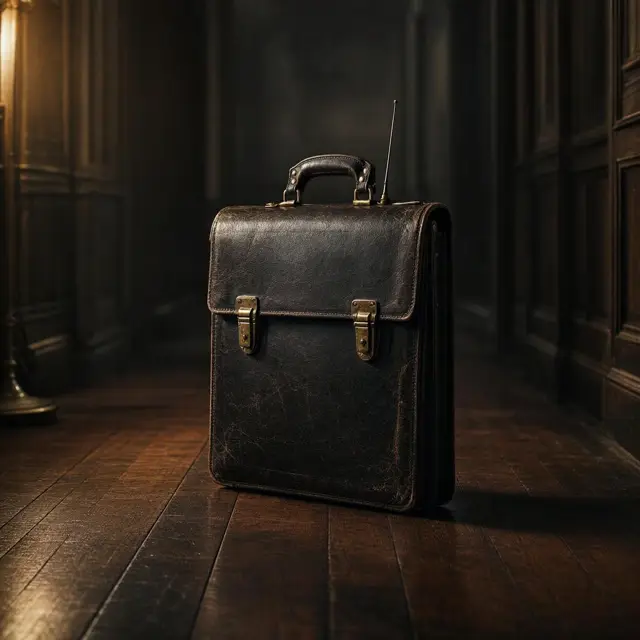
The bag itself has been described both as a metal briefcase and as a leather one weighing about 45 pounds (20 kg). Photos exist of the leather version. A small antenna sticks out near the handle, which suggests there is some kind of communications gear inside too.
The Biscuit and Two Secret Letters
Before any order can be carried out, the military has to be sure it is really talking to the president. That is the job of a plastic card nicknamed the "biscuit."
The check works like a password game. The president reads two daily phonetic letters from the biscuit. A deputy director at the National Military Command Center then confirms or denies that they are correct. Only a correct answer shows that the person speaking really is the president. Further down the line, launch sites follow a two-man rule, so no single person acts alone. A two-person check also happens before codes are entered into a permissive action link.
There are limits, too. US law says any attack must be lawful, and military officers are required to refuse unlawful orders. Ready-made strike plans are checked by lawyers in advance. Advisers such as the chairman of the Joint Chiefs of Staff can advise, but by law have no operational control over US forces.
Three Footballs and a Noon Deadline
There are three footballs in total. One goes with the president, one with the vice president, and a spare stays at the White House. Giving the vice president a football began during the Carter administration.
The bag is carried by one of several rotating military aides, one from each of the six armed forces service branches. Each is a commissioned officer who has passed the nation's toughest background check, known as Yankee White. Their work schedule is top secret. They stay standing or walking near the president at all times, including on Air Force One, on Marine One, and in the motorcade.
The handover between presidents runs like clockwork. The incoming president gets a nuclear briefing just before the inauguration, along with a biscuit that switches on at exactly 12:00:00 noon. The outgoing president's codes work only until 11:59:59 a.m. Then they shut off automatically, and the aide carrying that football returns to Washington, D.C.
The Times the Football Got Left Behind
For such a closely guarded bag, it has had some surprising slips. At Camp David in 1973, Soviet leader Leonid Brezhnev suddenly drove off with President Richard Nixon in a Lincoln Continental that Nixon had given him. Nixon was separated from the Secret Service and, most likely, from the aide with the bag.
President Jimmy Carter began carrying the biscuit in his jacket pocket. He supposedly lost it when the suit went to the dry cleaner. In 1981, after Ronald Reagan was rushed to hospital following an attempt on his life, his biscuit was later found lying in one of his shoes on the emergency room floor. The aide with the rest of the football had been left behind as the motorcade sped away.
In 1999, President Bill Clinton quickly left a NATO summit that ended early, and the aide got left behind again. The aide simply walked back to the White House, football in hand, "without incident."