Three Hearts and Blue Blood
The octopus is built very differently from us. It has three hearts. One main heart pumps blood around the body, while two smaller hearts push blood through its two gills.
Its blood is blue. Instead of the iron-based protein that makes our blood red, octopus blood uses a copper-rich protein called haemocyanin to carry oxygen. It works better than ours in cold water with little oxygen, but it makes the blood thick, so the hearts have to pump hard.
There is an odd catch. The main heart stops beating while the octopus swims. That makes swimming tiring, which is why octopuses mostly crawl.
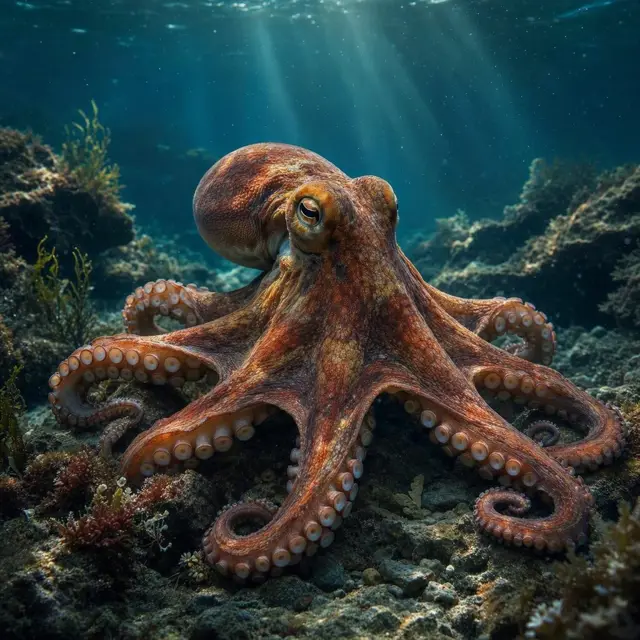
The body is almost entirely soft, with no skeleton at all. Even large octopuses can squeeze through a gap little more than 2.5 centimetres wide. The only hard part is a sharp beak in the middle, where the eight arms meet.
A Brain Spread Through Eight Arms
Octopuses have around 500 million nerve cells, each one a neuron, about the same number as a dog. But only a third of them are in the head. Two-thirds sit in the nerve cords that run down the arms.
This lets each arm act with a surprising amount of independence. Learning happens mainly in the brain, but the arms make their own decisions once they have information. A cut-off arm can still move and respond when touched. The suckers are covered in taste sensors, so an octopus tastes whatever it grabs.
All that brainpower shows. In experiments, octopuses solve mazes and puzzles and remember what they learned. The veined octopus collects empty coconut shells and carries them around to build a shelter, a clear example of tool use. Octopuses have even been seen playing, pushing a bottle around with jets of water.
They are famous escape artists, too. They often break out of aquarium tanks, sometimes sneaking into other tanks to find food.
Masters of Disguise
An octopus can change colour in an instant. Its skin is packed with special cells, each one a chromatophore filled with yellow, orange, red, brown or black colour. By stretching or squeezing them, the octopus can match its surroundings, scare off an attacker or signal to other octopuses.
It can change texture as well. Muscles in the skin raise bumps so the body looks like a rock covered in algae. Some octopuses pull off a moving rock trick, pretending to be a rock and creeping across open ground at the same speed as the moving water around them.
The mimic octopus goes even further. It shapes its body and colours to look like more dangerous animals, such as lionfish, sea snakes and eels.
If all that fails, there is the ink. An octopus can squirt a dark cloud mixed with mucus that works as a smokescreen or a decoy, and may confuse an attacker's sense of smell. Some can even let go of an arm to escape, and grow it back later.
Short Lives and Deadly Blue Rings
For such clever animals, octopuses live very short lives, up to about four years at most. Some species finish their whole life cycle in less than six months.
The end is built in. Males decline after mating. Females lay their eggs, then stop eating while they guard them. A female giant Pacific octopus protects her eggs for about five months until they hatch. A gland then triggers a final stage called senescence, in which the body breaks down and the octopus dies.
All octopuses are venomous, but only one group is known to be deadly to people: the blue-ringed octopuses. Their bright blue rings stay hidden in folds of skin and flash into view when the animal feels threatened. The venom contains tetrodotoxin, which blocks nerve signals and can stop a person breathing. There is no known antidote, but if breathing is kept going with help, patients recover within 24 hours.
Thankfully, they only bite when provoked or touched by accident.