A Place Named After Talking
The word parliament hides its purpose in plain sight. It comes from the Old French word parlement, meaning discussion, which in turn comes from parler, 'to talk'. English picked up the term from Anglo-Norman in the 14th century. At first it could mean almost any discussion or negotiation, often by a group called together by a monarch.
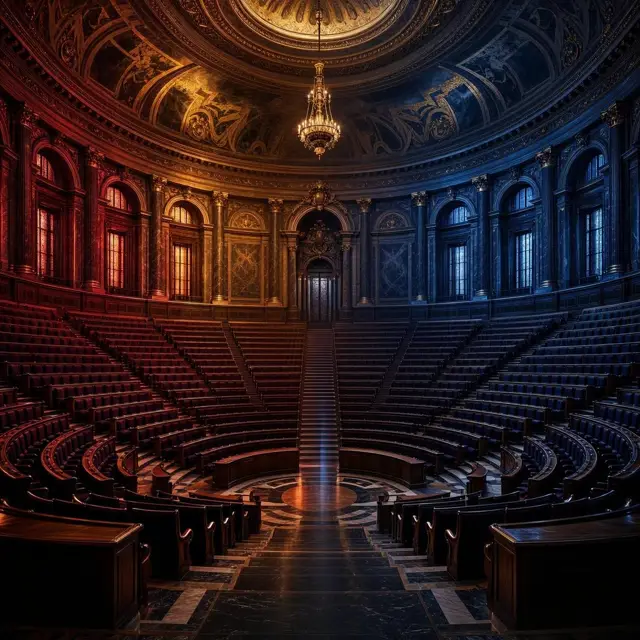
By the 15th century, in Britain, the word had narrowed to mean the legislature. Today a parliament usually has three jobs. It represents the voters, it makes laws, and it keeps watch over the government through hearings and inquiries. Most of its members are elected.
The term is most common in countries that are, or once were, monarchies. But it turns up elsewhere too. Ghana, for example, has a parliament even though the country uses a presidential system.
Iceland's Althing and the Viking Thing
Long before modern parliaments, Germanic societies met in an assembly called a thing. It was made up of the free men of a community. The thing met at regular intervals. It made laws, elected chieftains and kings, settled disputes and judged cases. The meeting place was often also a place for trade.
The law itself was memorised and recited aloud by a law speaker, who also acted as the judge. Local things sent representatives to bigger things, so the assemblies formed a kind of ladder, from the local level up to a whole province or country.
The Vikings copied this system in the lands they conquered. Iceland's Althing, dating from 930, is one result. The Faroese Løgting dates from a similar period, and the Manx Tynwald claims to be over 1,000 years old. In Sweden and Finland the national parliament is still called the riksdag, a word used since the Middle Ages.
When Kings Had to Ask First
Medieval parliaments began to set up a big idea: that monarchs were subject to law. In 1188, King Alfonso IX of León faced attacks from two neighbours, Castile and Portugal. He needed support, so he called not only nobles and bishops but also representatives of the middle class from the most important cities. UNESCO calls the decrees of this Cortes of León the oldest record of the European parliamentary system.
In England, powerful landholders forced King John to accept Magna Carta in 1215. It said the king could not collect most taxes without the consent of a council. In 1265, Simon de Montfort, then in rebellion against Henry III, called a parliament without royal permission. For the first time the towns were represented, each sending two men, each one a burgess.
Edward I borrowed these ideas in 1295 for what became known as the Model Parliament, because it set the pattern for later ones. In 1307 he agreed not to collect certain taxes without the consent of the realm through parliament.
Bells, Thinking and Electing Kings
Other parts of Europe built their own assemblies. Poland's parliament, the Sejm, grew around 1180 out of an older council called the wiec. From 1374, the Polish king needed the assembly's permission to raise taxes. In 1493 a Senate joined it as a second chamber, and in 1573 an assembly set up a monarchy in which kings were elected.
In the medieval republic of Novgorod, the highest law-making body was the veche. Stories say anyone could call it together by ringing the veche bell, though the real process was probably more complex. The bell became a symbol of the city's independence. Novgorod's veche lasted until 1478.
The names of these bodies often describe what happens inside them. Parliament comes from talking. Russia's lower house, the State Duma, takes its name from the Russian word for 'to think'. Switzerland's Federal Diet ran from the 13th century all the way to 1848, making it one of the longest-lived representative bodies in history.
Readings, Lords and Votes of No Confidence
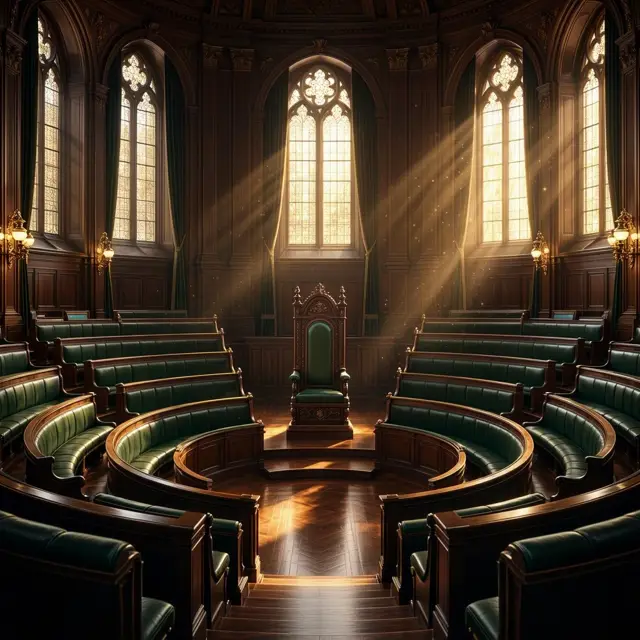
Britain's parliament is often called the Mother of Parliaments. That is actually a misquote. In 1865 John Bright said 'England is the Mother of Parliaments'. Still, the British model, known as the Westminster system, has been copied in many countries. Many have a mostly ceremonial head of state, a large elected lower house and a smaller upper house.
In the UK, the House of Commons has 650 elected members. Each stage of debate on a bill is called a reading. The first reading is a formality, the second looks at the bill as a whole, and the third looks at the details. There is also a committee stage. Once both houses agree, Royal Assent turns the bill into law. Since the Parliament Acts of 1911 and 1949, the Lords can block a money bill for only a month.
In a parliamentary system, the government answers to parliament. If members lose faith in the prime minister, they can call a vote of no confidence and force a resignation. In a presidential system, such as the American one, removing the head of government takes impeachment instead.