It is almost never a grain of sand
Ask most people how a pearl forms and they will mention a grain of sand. That is rarely what happens. The usual triggers are bits of organic material, parasites, or a small injury that pushes living tissue to the wrong place inside the shell. These intruders slip in while the shell is open for feeding or breathing.
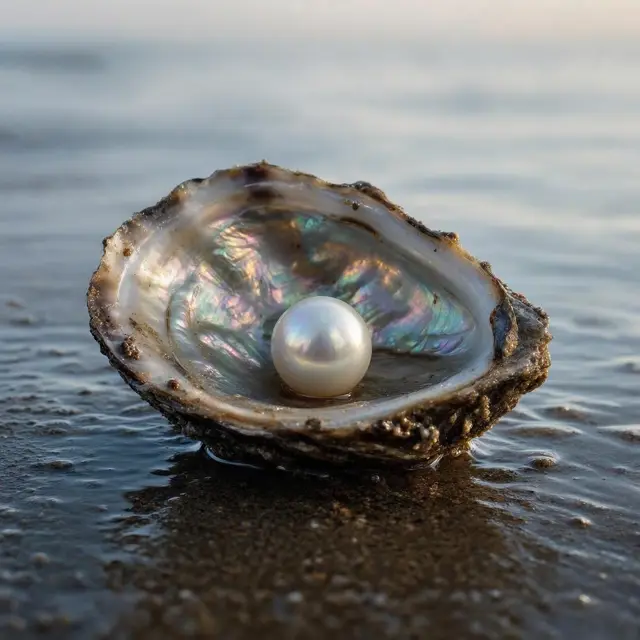
The animal responds with its mantle, the soft tissue that also builds its shell. The mantle forms a little pocket around the intruder and coats it again and again with calcium carbonate. Those crystals are held together by conchiolin, a horn-like natural material. Together they make nacre, the same shiny stuff that lines the inside of the shell as mother-of-pearl.
The thinner and more numerous the layers, the finer the glow. Light breaking up across the overlapping layers creates the shimmer called iridescence. And because a pearl is mostly calcium carbonate, vinegar can dissolve it.
Three tons of oysters for three perfect pearls
Wild pearls, the kind that form with no human help, are extremely rare. Before the 20th century, divers pulled oysters off sea floors and river bottoms and checked each one by hand. In a haul of three tons, only three or four oysters held perfect pearls. Many hundreds of shells had to be opened to find even one wild pearl.
That rarity made prices soar. In 1917, jeweler Pierre Cartier bought the Fifth Avenue mansion that is now the New York Cartier store. He paid for it with a matched double strand of natural pearls, valued at the time at 1 million US dollars.
Some single pearls became famous. One called La Peregrina was found at Panama in 1560 and offered to Philip II of Spain. He found it so beautiful that he kept it for himself. It later joined the Spanish Crown Jewels and appeared in every royal inventory for more than 200 years.
The farm trick that changed everything
Today most pearls sold are farmed. A cultured pearl starts when a tiny piece of tissue from one shell is placed inside another, often along with a polished bead. The host shell then builds a pearl around it, much as it would around a natural intruder.
Many people credit Mikimoto with inventing this, but that is a common misconception. The method was developed by British biologist William Saville-Kent in Australia and brought to Japan by Tokichi Nishikawa and Tatsuhei Mise. Nishikawa was granted the patent in 1916.
Farming changed the clock. Akoya pearls are usually harvested after one year, and Tahitian and South Sea pearls after 2 to 4 years. Freshwater mussels can take up to 25 grafts on each side, which is why their pearls flood the market. China now produces more than 1,500 metric tons of freshwater pearls a year. By the 1950s, natural pearls had shrunk to a small, exclusive niche.
Real, farmed or fake? Rub two together
Telling pearls apart is often a job for X-rays. A natural pearl shows a series of growth rings, layer after layer. A beaded cultured pearl shows a solid center with no rings at all. Without this test, natural pearls and some farmed ones can be very hard to tell apart.
There is also a simple test for fakes. Rub two pearls against each other. Imitation pearls feel completely smooth, while real ones, natural or cultured, feel slightly gritty because nacre is built from tiny plates. Some fakes are glass beads coated with a solution made from fish scales.
Color can fool you too. Most cheap colored pearls have been dyed, often with a fabric dye that only reaches the first layer or two. Truly valuable pearls are never dyed. Natural black pearls were once extremely rare, because white pearl oysters seldom made black pearls, and black pearl oysters seldom made any pearls at all.
Pink, blue and a pearl that weighs 34 kilograms
Almost any shelled mollusk can make some kind of pearl, even edible mussels and snails. Most of these are dull and worthless. A few are spectacular. The queen conch, a large Caribbean sea snail, very rarely grows pink pearls with a shimmering pattern called 'flame structure'. An abalone in New Zealand waters gives 'blue pearls' with bright colors often compared to opal. A farm in Mexico grows pearls from rainbow-lipped oysters that glow red under ultraviolet light.
Then there are the giants. The largest known pearl, the Pearl of Puerto, came from a giant clam in the Philippines. It is 67 cm long and weighs 34 kg. The second largest, also from a giant clam in the Philippines, was found in 1934 and weighs 6.4 kg. Instead of a pearly shine, its surface is glossy like porcelain.
Most pearls are not perfectly round. Irregular ones are called baroque pearls, while perfectly round pearls remain the rarest and most valuable shape.