The Mould That Killed Bacteria
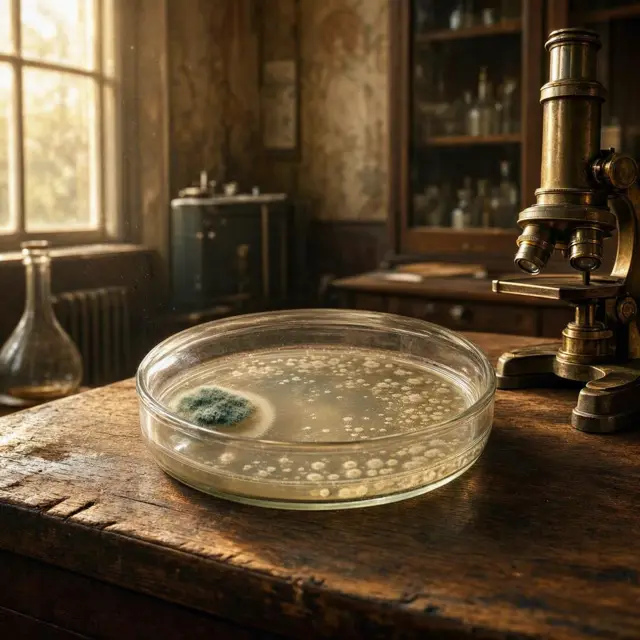
On 3 September 1928, the Scottish doctor Alexander Fleming noticed something odd at St Mary's Hospital in London. A mould had got into a bacterial culture, and it seemed to be killing the bacteria. He repeated the test on 28 September and confirmed what he saw. The mould was later identified as Penicillium rubens.
Fleming needed a name. On 7 March 1929 he coined 'penicillin', he wrote, to avoid repeating the clumsy phrase 'mould broth filtrate'. He simply followed the mould's scientific name, the same way the drug digitalin was named after the Digitalis plant. He published his experiment that year.
Then very little happened. Fleming could not convince anyone that his find mattered, mostly because penicillin was so hard to isolate that turning it into a drug seemed impossible. Some think it might have been developed years earlier if he had stirred up more interest. Other people had reported the germ-killing power of Penicillium since the late 19th century, but no one had worked out what caused it.
Oxford Turns It Into Medicine
In 1930, Fleming's former student Cecil George Paine, a doctor in Sheffield, used the crude extract to treat an eye infection in newborn babies. The real breakthrough came in 1940 at the University of Oxford. A team led by Howard Florey and Ernst Chain, including Norman Heatley and others, learned to make concentrated penicillin that killed bacteria both in the lab and in living bodies.
Supplies were tiny. In 1941 the team treated a policeman, Albert Alexander, for a serious face infection. He began to get better, but the penicillin ran out and he did not survive. In 1942 Florey gave the only available sample to Fleming, who used it to cure a man named Harry Lambert of streptococcal meningitis. Lambert improved the very next day and was cured within a week.
In 1945 Fleming, Florey and Chain shared the Nobel Prize in Physiology or Medicine. Florey never patented penicillin, because Sir Henry Dale advised him it would be unethical. That same year Dorothy Crowfoot Hodgkin, also at Oxford, used X-ray crystallography to confirm penicillin's structure.
A Mouldy Melon Goes to War
Oxford could not make penicillin in useful amounts. So in June 1941 Florey and Heatley travelled to the United States with their mould samples. They found help at a government research lab in Peoria, Illinois, which already had equipment for large-scale fermentation. The search for better moulds began right away.
Early supplies were painfully small. In March 1942, half of the entire US supply went to a single patient, Anne Miller. By June 1942 there was just enough for ten patients. The body clears about 80 percent of a dose within three to four hours, and the drug was so precious that it became common to collect patients' urine, recover the penicillin in it and use it again.
Then came a lucky find. In 1943 a mouldy cantaloupe in a Peoria market turned out to carry the best strain yet, making six times as much penicillin as Fleming's mould. Growing it in corn steep liquor, and later in huge tanks through deep-tank fermentation, changed everything. The US made 2.3 million doses in time for the Normandy invasion in 1944, and by June 1945 it was producing over 646 billion units a year.
How Penicillin Breaks a Bacterium
Bacteria are wrapped in a cell wall made of a material called peptidoglycan. As they grow and divide, bacteria keep building and breaking down parts of this wall at the same time. Penicillin jams the building side. It stops the final step, where the strands of the wall are linked together.
The key part of the penicillin molecule is a small four-membered structure called the beta-lactam ring. Penicillin uses it to latch onto the enzymes that make those links, known as penicillin-binding proteins. With those enzymes blocked, the wall grows weak while the breaking-down enzymes keep working. Water flows into the cell without control, and the cell bursts and dies.
Some bacteria are easier targets than others. Some have only a thick cell wall and no outer membrane, so penicillin passes through easily. Others have an extra fatty outer layer that blocks it. Penicillin can only get into them through small channels in that layer, and larger molecules pass through more slowly.
The Bacteria Fight Back
Fleming himself noticed in 1928 that many bacteria were not affected by penicillin. In 1940, Chain and Edward Abraham found out why. Bacteria such as E. coli made an enzyme that broke penicillin apart. They named it penicillinase. Today it belongs to a large family of enzymes, each one a beta-lactamase, with over 2,000 known types. This kind of destruction is the most important way bacteria resist penicillin.
Scientists answered with new versions. In 1957 researchers discovered 6-APA, the core of the penicillin molecule, and by adding new side groups to it they created new penicillins. Ampicillin arrived in 1961 and worked against a wider range of bacteria. Methicillin resisted beta-lactamase, but a strain called MRSA appeared after it was introduced in 1959, and it resists most antibiotics.
Today two purified penicillins are in clinical use. Penicillin G is destroyed by stomach acid, so it is given by injection, while penicillin V can be taken by mouth. In the United States, 10 percent of people say they are allergic to penicillin, yet 90 percent of them can eventually take it.