Rows, Columns and a Repeating Pattern
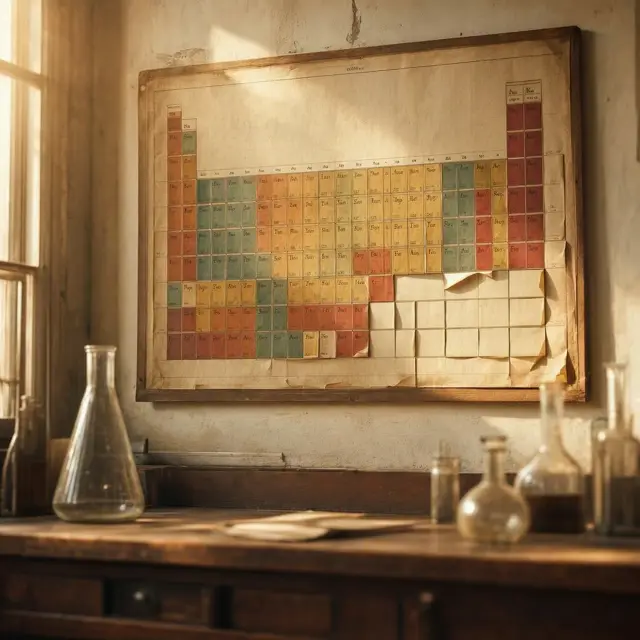
The periodic table arranges the chemical elements into rows called periods and columns called groups. It is a picture of the periodic law, which says that when the elements are lined up in order of their atomic numbers, their properties come back around again and again.
That repetition is the whole point. Elements sitting in the same column tend to behave in similar ways chemically, which is why the layout is useful rather than merely tidy. Sodium and potassium share a column, and they share habits.
Trends run in several directions at once. Metallic character grows as you move down a column and as you move right to left across a row, while non-metallic character increases toward the top right corner. The table also splits into four roughly rectangular regions called blocks.
Before anyone had a full table, chemists were finding fragments of the pattern. In 1829, Johann Dobereiner noticed that certain elements fell into groups of three with related properties, which he called triads. Nobody could stitch the pieces into a single scheme.
The Gaps Were the Argument
Dmitri Mendeleev started arranging elements by atomic weight on 17 February 1869, and by the end of that day his system covered most of the elements then known. His table was published that May.
What made it convincing was his willingness to bet on it. When an element refused to fit, he did not bend the table. He declared that the measurement must be wrong, or that an undiscovered element belonged in that spot. In 1871 he went further and described in detail what three missing elements would be like, naming them after the elements above them.
The bet paid off. In 1875 a French chemist found gallium and Mendeleev wrote to say it was his predicted eka-aluminium. The discoverer was suspicious at first, then agreed. Scandium turned up in 1879 and germanium in 1886, matching the other two predictions. Even the noble gases, which Mendeleev had not foreseen at all, slotted in neatly as a new column at the end of the century.
Weight Was the Wrong Ruler
Mendeleev ordered his elements by atomic weight, and that mostly worked. It also produced stubborn exceptions, such as tellurium and iodine, where the chemistry insisted on one order and the weights insisted on the other.
The fix came in 1913, when the Dutch physicist Antonius van den Broek proposed that an element's place depends on the charge of its nucleus. Ernest Rutherford named that quantity the atomic number. The same year, Henry Moseley used X-ray spectroscopy to measure it for every element from aluminium to gold and showed that Mendeleev's ordering had in fact been sorting them by nuclear charge all along.
This turned the table into something exact. Atomic number is a whole number, so there is no ambiguity about sequence and no room for argument about weights. It also showed precisely which elements were still missing: numbers 43, 61, 72, 75, 85 and 87. Moseley was killed in the First World War soon after.
Making the Missing Ones
By 1936 only four gaps remained below uranium. Element 43 became the first element ever made artificially rather than found, produced in 1937 and named technetium from the Greek word for artificial. Elements 85 and 61 were also manufactured, in 1940 and 1945. Francium, element 87, was the last element to be discovered in nature, in 1939.
Everything past uranium had to be built. Neptunium came in 1940 from bombarding uranium with neutrons, then Glenn Seaborg's team at Berkeley produced plutonium in 1941 and kept going. Seaborg also worked out that the elements from actinium onward belong in their own family, the actinides, which gave the table the shape we recognise today.
The later rows got political. Through the 1960s and 1970s, American and Soviet teams each claimed elements 102 to 106 and each proposed names, a dispute that dragged on for decades and was only settled in 1997. By 2016 the first seven rows were complete, all the way to element 118.